The Blast Furnace Needs More Than Automation: It Needs a Smarter Level 2
Hybrid first-principles + machine-learning process control for more stable, efficient and explainable ironmaking
By ExtractMet Private Limited
A modern blast furnace is one of the most intensively instrumented, energy-intensive and operationally demanding units in an integrated steel plant. Yet the variables that matter most to operators—internal thermal state, burden descent, cohesive-zone behaviour, reduction progress, gas utilization, raceway response and the future quality of hot metal—cannot all be measured directly or continuously.
That is why the next step in blast-furnace automation is not simply “more data.”
It is a smarter Level-2 process-intelligence layer that converts plant data into an estimate of the furnace state, predicts where the process is heading, and recommends actions that remain consistent with metallurgy, mass balance, heat balance and plant constraints.
At ExtractMet, we are developing plant-specific blast-furnace process-control and digital-twin solutions based on a hybrid approach: first-principles modelling + dynamic state estimation + machine learning + operator-focused decision support.
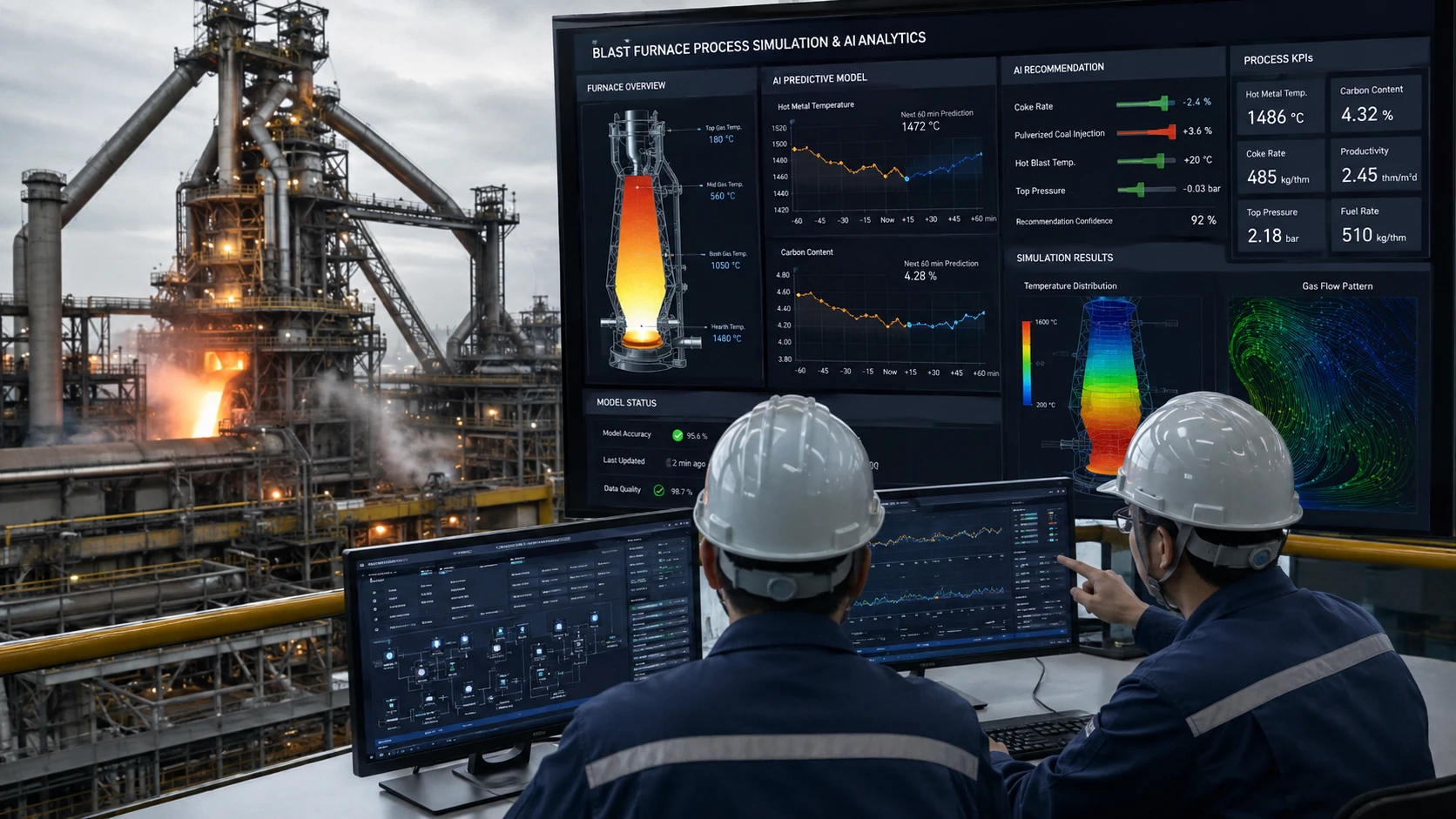
**Suggested hero image:** `01_extractmet_blast_furnace_digital_twin.png`
**Caption:** *Blast-furnace ironmaking needs a process-intelligence layer that connects burden, gas, heat, reactions and hot-metal outcomes.*
Why blast-furnace control remains difficult
A blast furnace is not a simple input-output reactor. It is a large counter-current moving-bed reactor with strongly coupled thermal, chemical, flow and phase-change phenomena. Operational disturbances can arise from burden quality, particle size, coke strength, charging distribution, pulverized-coal injection, blast temperature, oxygen enrichment, moisture, tuyere conditions, tapping practice and many other factors.
More importantly, the response is often delayed.
A change made now may influence measured top-gas, hot-metal temperature, silicon, slag chemistry or pressure behaviour only after a significant process delay. By the time an undesirable trend becomes visible in conventional measurements, the cause may already be several hours old.
This is precisely where a well-designed Level-2 system creates value.
Instead of asking only:
“What is the furnace doing now?”
a useful process-control model asks:
“What internal state best explains the current measurements, what is likely to happen next, and which controllable action gives the safest and most economical response?”
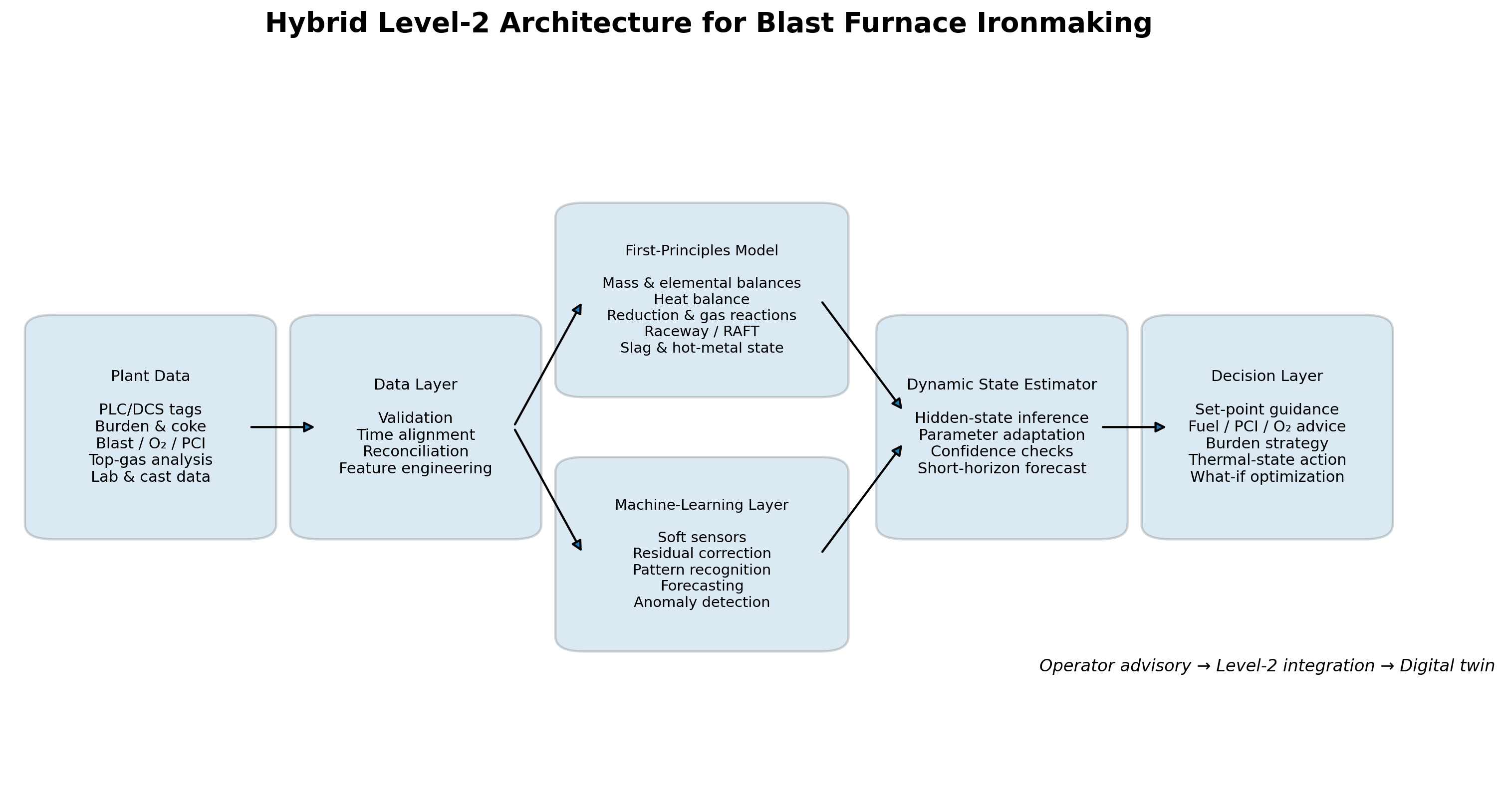
*Figure 1. A hybrid Level-2 architecture combines validated plant data, first-principles calculations, machine-learning models, state estimation and decision support.*
The core idea: combine physics and data rather than choosing between them
Purely first-principles models are powerful because they enforce conservation laws and metallurgical logic. They can represent mass and elemental balances, heat balance, gas generation and consumption, reduction reactions, coke and PCI behaviour, slag formation, burden and gas interaction, raceway conditions and hot-metal production.
But any industrial blast furnace contains uncertainties. Raw materials vary. Measurements drift. Simplifying assumptions are unavoidable. Some important phenomena are difficult to represent at the speed required for online operation.
Purely data-driven machine-learning models solve a different problem. They can learn nonlinear relationships from plant history, identify correlations that are difficult to derive analytically, build soft sensors for unmeasured states, detect patterns preceding abnormal operation, and generate rapid forecasts.
But a machine-learning model trained only on historical data can become unreliable when the furnace moves outside its training envelope.
The stronger solution is therefore hybrid:
- **Physics provides the backbone.**
- **Plant data calibrates the model.**
- **Machine learning corrects systematic residuals and estimates difficult-to-measure states.**
- **Dynamic logic represents process delays and inventories.**
- **Optimization converts predictions into practical operating recommendations.**
This hybrid philosophy is increasingly aligned with published blast-furnace control research, where dynamic first-principles or semi-parametric models have been combined with data-driven elements for prediction and control of hot-metal and slag quality.
Static and dynamic models should work together
A practical Level-2 system should not force one mathematical model to do everything. Two complementary time scales are useful.
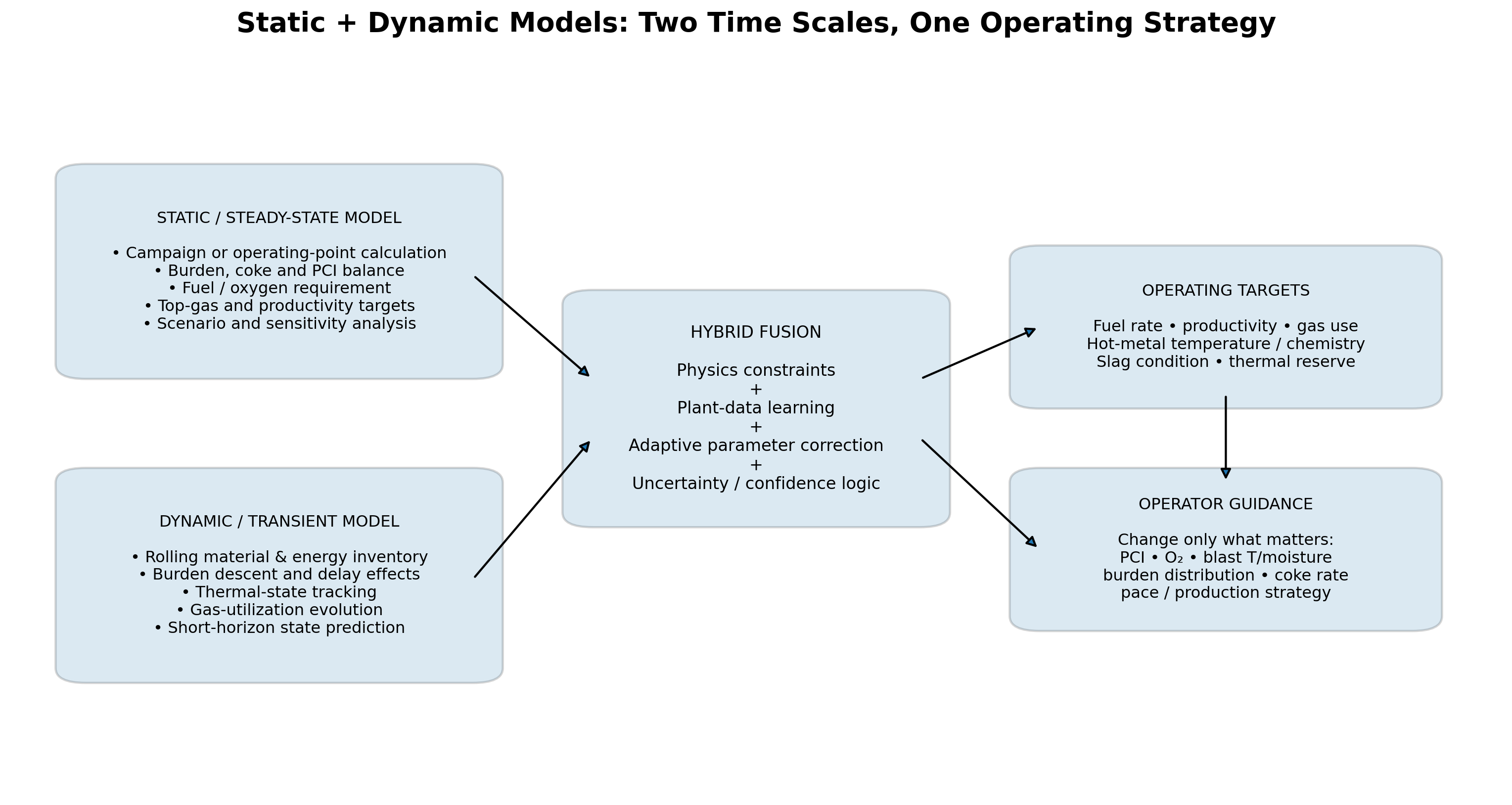
*Figure 2. The static model establishes the operating window; the dynamic model tracks how the furnace moves inside or outside that window.*
1. Static / steady-state model
The static model answers questions such as:
- What coke and PCI rate is required for the present burden and blast practice?
- What oxygen enrichment and blast temperature are compatible with a desired thermal state?
- What top-gas composition and gas utilization should be expected?
- What is the expected hot-metal and slag production?
- How will a new ore blend, coke quality, PCI coal or flux practice change the furnace balance?
- What is the sensitivity of fuel rate and productivity to the proposed operating change?
A well-configured static model is therefore the engineering baseline for burden design, fuel strategy, production planning and scenario evaluation.
2. Dynamic / transient model
The dynamic model continuously updates the furnace state as new data arrive.
It can track the consequences of:
- burden charging and descent,
- time-varying blast and oxygen practice,
- PCI changes,
- top-pressure and gas-flow behaviour,
- evolving reduction and thermal state,
- stockline and permeability indicators,
- delayed hot-metal and slag response,
- tapping events and liquid inventory.
The objective is not merely to redraw a trend chart. The objective is to maintain an internally consistent estimate of what is happening inside the furnace.
A useful Level 2 should estimate the states that operators cannot directly measure
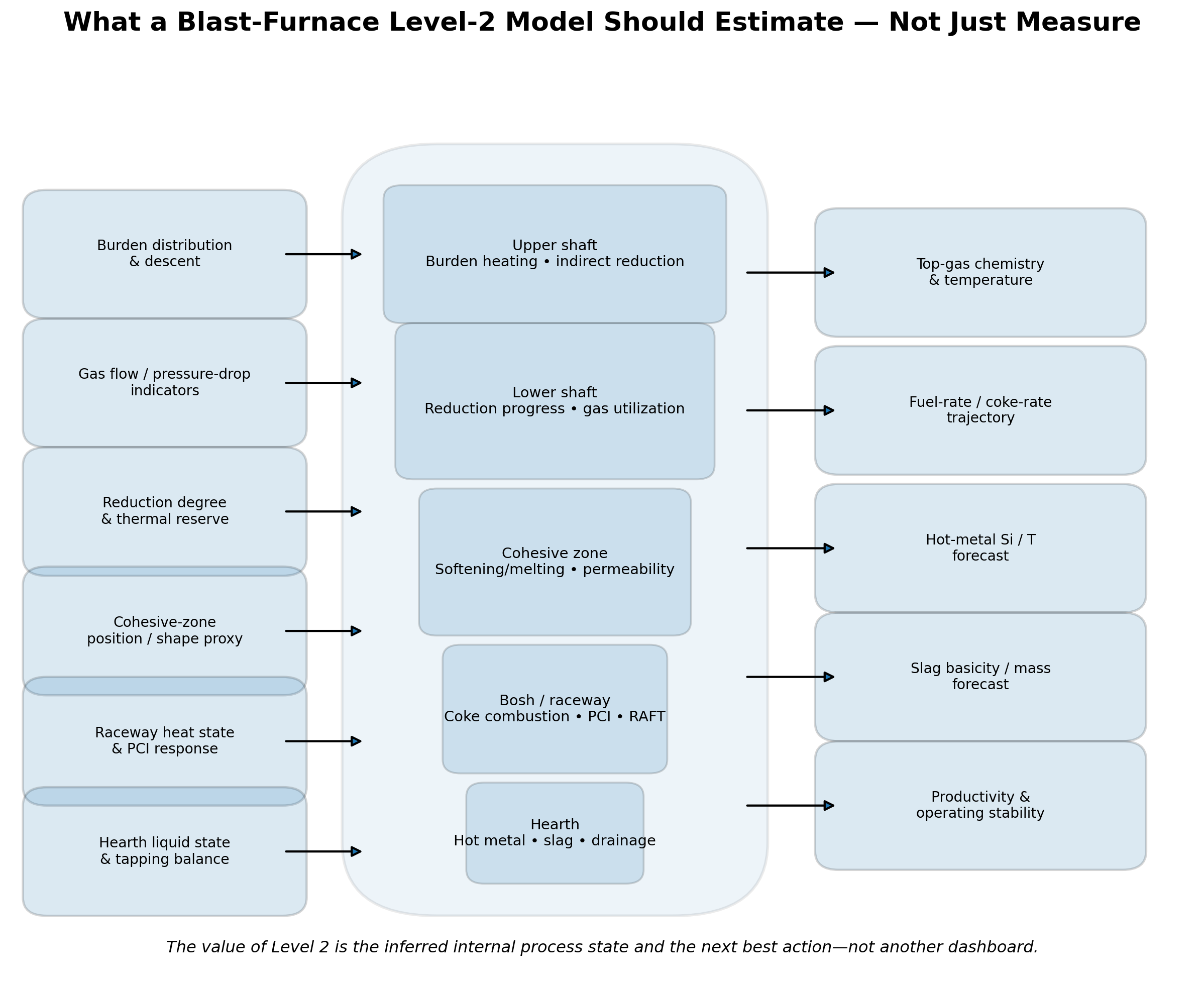
*Figure 3. A Level-2 model becomes valuable when it estimates hidden internal process states and connects them to future measurable outcomes.*
Depending on available instrumentation and the plant objective, a hybrid blast-furnace Level-2 system can be configured to estimate or predict:
Thermal and reduction state
- thermal reserve indicators,
- shaft reduction progress,
- solution-loss and direct-reduction contribution,
- raceway adiabatic flame temperature and tuyere-zone energy,
- expected hot-metal temperature.
Burden and gas behaviour
- burden distribution effects,
- gas utilization,
- pressure-drop / permeability indicators,
- gas-flow imbalance risk,
- cohesive-zone position or proxy indicators.
Hot metal and slag
- hot-metal production rate,
- hot-metal silicon and selected chemistry indicators,
- slag rate and basicity,
- expected tapping conditions.
Fuel and productivity
- coke rate,
- PCI response,
- oxygen and blast requirement,
- fuel-rate trajectory,
- productivity and operating-window constraints.
Abnormal-condition prediction
- developing thermal deviation,
- deteriorating permeability,
- unstable gas-flow pattern,
- deviation between modelled and measured furnace response,
- sensor or data-quality anomalies.
From prediction to action: what should the operator actually see?
The best process model is not the one with the largest number of equations. It is the one that helps the operating team make a better decision.
A practical operator interface should therefore convert complex calculations into a small number of high-value messages:
Current state
“Thermal state is trending below the desired operating band.”
Why the model thinks so
“Top-gas utilization, estimated reduction progress and the predicted hot-metal temperature are moving consistently in the same direction.”
What happens if no action is taken
“Expected hot-metal temperature and silicon are likely to move below the target band after the current burden delay.”
Recommended action
“Compare a controlled adjustment in PCI, oxygen enrichment, blast temperature or burden strategy within approved plant limits.”
Confidence
“Recommendation confidence: high / moderate / low, based on data quality and model agreement.”
This last point matters. A credible Level-2 system should communicate uncertainty instead of presenting every prediction as equally certain.
Where machine learning adds the most value
Machine learning is most useful when it is applied to a well-defined metallurgical problem, rather than used as an abstract “AI layer.”
High-value applications include:
Soft sensors
Estimate variables that are expensive, delayed or impossible to measure continuously—for example future hot-metal temperature or silicon based on current and lagged process data.
Residual correction
Let the first-principles model calculate the physically consistent baseline, then allow an ML model to learn the systematic difference between prediction and plant behaviour.
Dynamic forecasting
Predict the near-future evolution of top-gas, hot-metal quality, pressure, thermal indicators or productivity using time-series information.
Abnormal-pattern recognition
Identify combinations of signals that historically preceded unstable operation.
Adaptive model calibration
Update uncertain parameters as burden quality, campaign condition or operating strategy changes.
The result is a model that is more explainable than a black-box predictor and more adaptive than a purely fixed first-principles simulation.
**Suggested image:** `05_extractmet_blast_furnace_ml_dashboard.png`
**Caption:** *Machine learning becomes most useful when it is connected to furnace physics, plant data and an operator decision.*
How ExtractMet approaches plant-specific Blast Furnace Level-2 development
At ExtractMet, the objective is not to offer a generic dashboard. The objective is to build a model around the specific operating decisions of the plant.
Our blast-furnace digital-twin portfolio is designed around burden, raceway, gas-solid heat and mass transfer, reduction, cohesive-zone behaviour and hot-metal/slag indicators. The model environment can track or predict top-gas chemistry and temperature, fuel rate, productivity, reduction and thermal indices, and hot-metal/slag conditions.
A typical development pathway is:
Phase 1 — Define the operating problem
Examples:
- reduce coke or total fuel rate,
- stabilize hot-metal temperature and silicon,
- improve gas utilization,
- evaluate higher PCI,
- optimize oxygen enrichment,
- diagnose permeability or burden-distribution problems,
- create a campaign-replay and operator-training tool,
- develop an advisory Level-2 system.
Phase 2 — Plant data audit
Map the available:
- PLC/DCS tags,
- historian signals,
- raw-material analyses,
- burden charging data,
- coke and PCI properties,
- hot-blast parameters,
- top-gas composition,
- pressure and temperature measurements,
- laboratory hot-metal and slag analyses,
- cast / tap records,
- operator events and shift logs.
The quality of the Level-2 system depends as much on correct time alignment and data validation as on the mathematics.
Phase 3 — First-principles model
Develop the plant-specific material, elemental and heat balances, reaction framework, gas balance, hot-metal/slag production logic and relevant sub-models.
Phase 4 — Dynamic state estimator
Introduce time-resolved inventories, process delays, burden movement, rolling state calculations and furnace-state reconstruction.
Phase 5 — AI / ML augmentation
Use plant history to calibrate uncertain parameters, construct soft sensors, correct model residuals and improve forecasts.
Phase 6 — Validation
Test the system against operating periods not used for model calibration.
Performance should be assessed not only by statistical error but by whether the model:
- preserves physical consistency,
- works across the intended operating window,
- recognizes disturbances,
- produces stable recommendations,
- fails safely when data quality is poor.
Phase 7 — Operator advisory or Level-2 deployment
Integrate the validated model with the historian, LIMS and automation environment as appropriate, subject to plant cybersecurity, interface and change-management requirements.
Start small: one high-value decision is enough
A plant does not need to digitize every blast-furnace phenomenon in the first project.
A focused pilot can begin with one measurable objective, for example:
“Predict hot-metal thermal state 1–3 hours ahead and provide operator guidance.”
or
“Build a hybrid model for coke/PCI/oxygen optimization under changing burden conditions.”
or
“Create a digital campaign replay model to identify the operating signatures preceding permeability deterioration.”
Once validated, the same architecture can be expanded into a broader Level-2 or digital-twin platform.
This staged approach is technically safer, easier to validate, and much more useful than trying to build a large “AI system” before the plant decision has been clearly defined.
Explore ExtractMet’s Blast Furnace modelling capability
ExtractMet already presents both first-principles blast-furnace simulation and machine-learning blast-furnace simulation in its online model environment, alongside a wider metallurgical digital-twin portfolio.
Explore the digital-twin portfolio:
Blast Furnace and metallurgical digital twins →
Browse the model catalogue:
Blast Furnace process-performance model →
Open the online model demonstration hub:
First-principles and machine-learning model demos →
Read more technical insights:
The opportunity
Blast-furnace operators already have process knowledge. Plants already have automation. Most large furnaces already generate huge volumes of data.
The missing layer is often the one that connects metallurgy, data and decisions.
A hybrid Level-2 system can provide that connection: a transparent model that respects first principles, learns from plant behaviour, estimates hidden process states and helps the operating team test the next action before taking it.
For steel producers interested in blast-furnace process optimization, static and dynamic control models, AI/ML-based soft sensors, operator advisory systems or plant-specific digital twins, ExtractMet is available to discuss a focused pilot or full Level-2 development program.
Discuss your blast-furnace application
Website: www.extractmet.com
Email: info@extractmet.com
Suggested Medium tags
Blast Furnace · Ironmaking · Process Control · Digital Twin · Machine Learning
Suggested SEO description
Hybrid Level-2 blast-furnace process control combining first-principles models, dynamic state estimation and machine learning for thermal-state prediction, fuel optimization, hot-metal quality and operator decision support.
Suggested social teaser
The next blast-furnace productivity gain may not come from another dashboard. It may come from a hybrid Level-2 model that knows what the furnace is doing inside—and where it is heading next.