A plant-specific approach combining first-principles metallurgy, dynamic state estimation and machine learning to make continuously charged EAF steelmaking more predictable, energy-aware and operator-friendly.
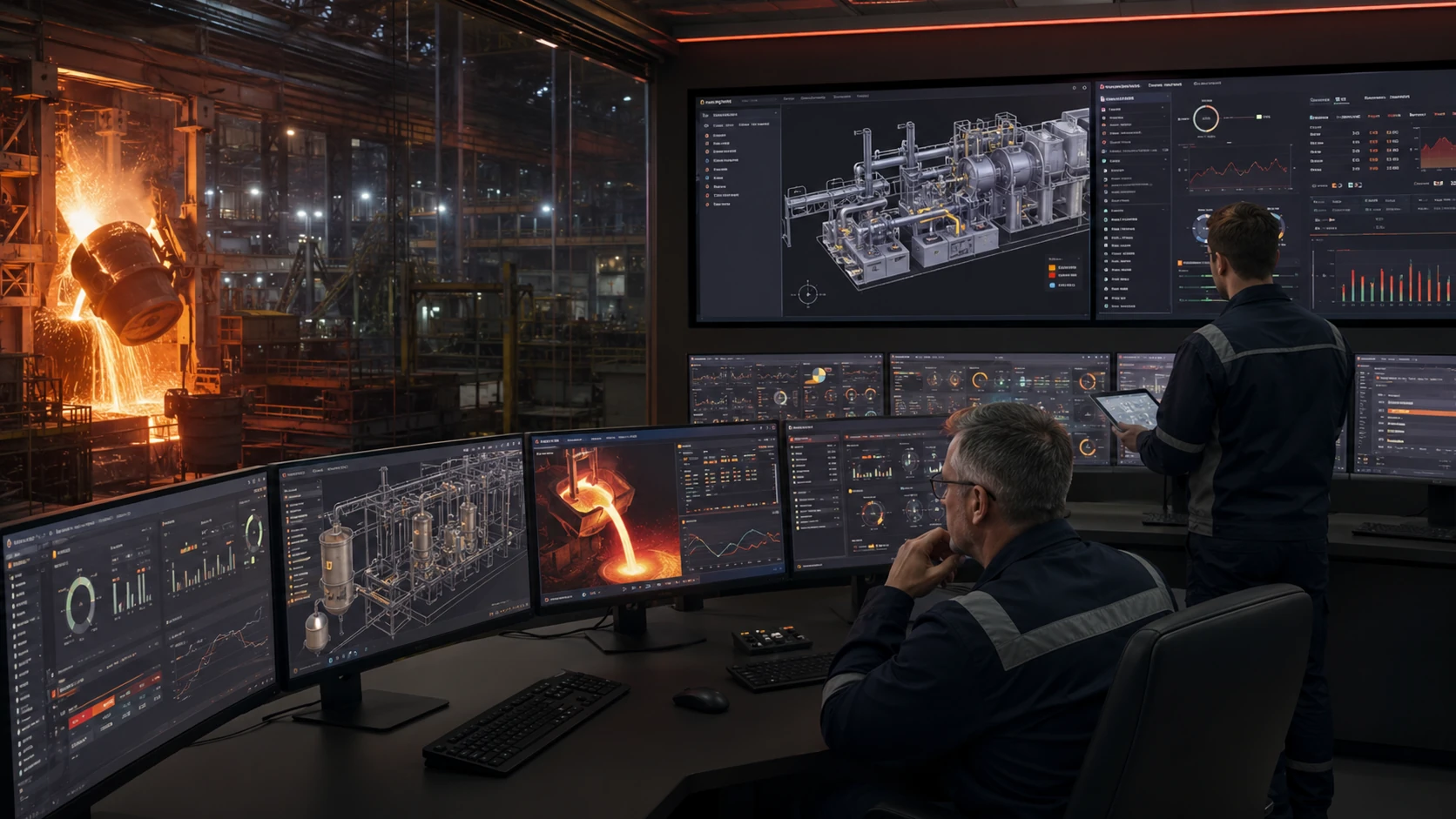 Suggested hero
image: ExtractMet process-modelling visual. Source: ExtractMet Private
Limited.
Suggested hero
image: ExtractMet process-modelling visual. Source: ExtractMet Private
Limited.
Electric Arc Furnace steelmaking is moving rapidly toward more flexible charge mixes, higher productivity, tighter energy targets and lower-carbon operations. In that transition, continuously charged EAF configurations such as Consteel® create a particularly interesting control problem: the furnace is no longer dominated by a few discrete scrap-basket events. Material, energy and chemistry evolve continuously—and the control system must evolve with them.
The core opportunity is straightforward:
If the charge enters continuously, the process state should also be estimated continuously.
That is where a modern Level-2 process-control layer can add value. Instead of relying only on fixed recipes, operator experience or end-of-heat measurements, a plant-specific Level-2 system can continuously reconcile feed, power, oxygen, carbon, fluxes, off-gas and furnace observations to estimate what is happening inside the steel bath, slag and gas phases.
At ExtractMet Private Limited, our process-control approach combines first-principles physics and metallurgy with machine-learning models. The aim is not to replace metallurgical reasoning with a black box. It is to build a transparent hybrid system in which conservation laws and thermochemistry provide the physical backbone, while data-driven models learn plant-specific effects that are difficult to describe perfectly from equations alone.
Explore ExtractMet: https://www.extractmet.com/?utm_source=medium&utm_medium=article&utm_campaign=consteel_eaf_level2
In a conventional top-charge EAF, scrap is typically introduced in discrete baskets. The furnace repeatedly transitions through charging, arc-boring, melting, refining and tapping-related stages. Continuous-charge systems change that operating rhythm.
In a Consteel®-type arrangement, charge materials are conveyed toward the furnace and can be preheated by process off-gas before entering the liquid bath region. The furnace can operate closer to a persistent flat-bath condition, while scrap feed, electrical energy, chemical energy, slag practice and off-gas behaviour remain strongly coupled.
This creates several control questions that are inherently dynamic:
A fixed recipe can answer these questions only indirectly. A dynamic Level-2 model can answer them heat-by-heat—and, ideally, minute-by-minute.
A practical Level-2 solution for a continuously charged EAF should sit between raw plant data and operating decisions. It should communicate with existing Level-1 automation, historian and laboratory systems without disturbing certified safety functions.
Recommended information flow:
Plant / Level 1 data → validation & reconciliation → first-principles model → dynamic state estimator → ML correction / soft sensors → optimizer → operator guidance or approved set-point recommendations
The result is not merely a dashboard. It becomes a continuously updated engineering model of the heat.
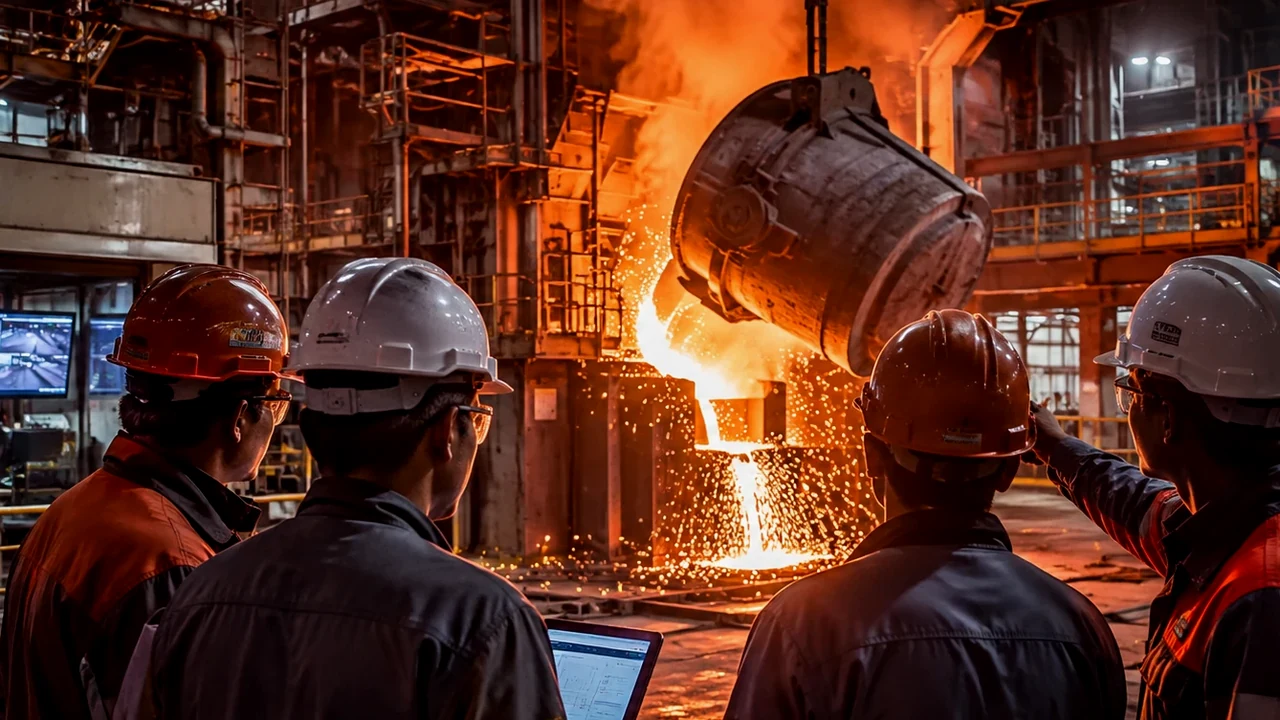 Suggested image: EAF
process-control / digital-twin visual. Source: ExtractMet Private
Limited.
Suggested image: EAF
process-control / digital-twin visual. Source: ExtractMet Private
Limited.
The static model provides the initial process plan. For a continuously charged EAF, it can be configured around the plant’s furnace size, metallic mix, conveyor operation, transformer characteristics, oxygen and carbon systems, flux strategy, target grade and operating constraints.
A useful static model can calculate or recommend:
The key is mass, elemental and heat balance closure. Before machine learning is introduced, the model should obey metallurgy.
The dynamic model advances the process through small time steps. Each time new feed enters or operating conditions change, the model updates the estimated furnace state.
Typical dynamic state variables include:
The model continuously asks a simple engineering question: Where did every kilogram, mole and megajoule go?
A rigorous physical model is essential—but an industrial EAF contains effects that are difficult to parameterize perfectly.
Examples include:
A purely physics-based model can therefore develop systematic residual errors. This is the ideal point for machine learning—not as a replacement for physics, but as an adaptive correction layer.
The hybrid Level-2 concept uses two complementary forms of intelligence.
This layer enforces physical consistency using:
This layer learns plant-specific residual behaviour from historical and live process data. Depending on data availability, ML models can support:
The most robust design is often a grey-box model: the ML layer is constrained by the physics model, rather than being allowed to produce physically impossible states.
One of the most valuable continuously charged EAF control variables is the scrap feed rate.
Feed too slowly and available electrical/chemical energy may be underutilized. Feed too aggressively and the model may predict excessive unmelted inventory, bath cooling, unstable process conditions or delayed endpoint achievement.
A dynamic Level-2 controller can estimate:
Net energy to bath = electrical energy + useful chemical energy + sensible heat of hot inputs − heat losses − energy consumed by reactions and melting
That estimate can be translated into a recommended feed rate, subject to conveyor capability, furnace constraints, grade requirements and operator rules.
The same framework can coordinate:
This is where continuously charged EAF operation can move from continuous material flow to continuous process optimization.
Off-gas analysis is especially valuable in EAF steelmaking because it provides a real-time window into chemical reactions that cannot be observed directly inside the bath.
With appropriate instrumentation and validation, off-gas CO/CO₂/O₂/H₂-related information, gas temperature and flow estimates can be integrated into the dynamic model to help infer:
The most useful model is not one that displays off-gas values. It is one that converts off-gas measurements into an updated metallurgical state and a recommended action.
A plant-specific HMI can be designed around decisions rather than raw tags. A typical screen could show:
This type of interface can also support operator training because every recommendation can be linked back to a physical or data-driven reason.
A Level-2 project does not need to begin with full closed-loop control. A lower-risk phased approach is usually better.
Map Level-1 tags, historian data, laboratory results, scrap records, energy data, oxygen/carbon flows, timestamps and operator events. Reconstruct historical heats and quantify data quality.
Develop the plant-specific mass, element and energy balance. Validate charge, energy, flux, oxygen and endpoint calculations.
Run the model heat-by-heat using historical or live data without issuing control actions. Compare predicted process states with measurements.
Train selected residual-correction models and soft sensors using historical heats. Test on unseen heats and changing operating campaigns.
Deploy recommendations for feed, energy, oxygen, carbon, flux and endpoint timing. Track acceptance and benefit.
Where justified and permitted by plant automation governance, integrate recommendations with Level-1 set-point workflows under defined limits, interlocks and operator authority.
This phased strategy allows value to be demonstrated before automation authority is increased.
A process-control project should be judged by plant KPIs, not by how sophisticated the algorithm sounds.
Typical validation targets can include changes in:
| Area | Example KPIs |
|---|---|
| Energy | kWh/t, oxygen efficiency, fuel consumption, post-combustion efficiency |
| Productivity | tap-to-tap time, power-on time, tonnes/hour, conveyor utilization |
| Endpoint | temperature prediction error, carbon prediction error, reblows/reheats/corrections |
| Metallic yield | tap weight, metallic yield, Fe losses to slag |
| Slag practice | FeO variability, foaming stability, flux consumption |
| Electrode / electrical | electrode consumption, arc stability, power-factor related indicators |
| Quality | chemistry hit rate, grade consistency, residual-element risk |
| Reliability | model availability, bad-data detection, prediction confidence |
| Sustainability | specific energy, carbon intensity, material yield and waste reduction |
No credible supplier should promise identical savings for every plant. Benefits depend on baseline practice, instrumentation, charge mix, furnace design, data quality and the degree of integration. The correct approach is to define a baseline, validate the model, run a controlled pilot and quantify the actual benefit.
ExtractMet focuses on metallurgical engineering problems where physical understanding and plant data need to work together.
Our existing steelmaking modelling framework can track material melting, metal and slag evolution, heat balance, reaction progress and off-gas behaviour through time. The same engineering philosophy can be configured for continuously charged EAF operations and extended into a plant-specific Level-2 or digital-twin implementation.
The core design principles are:
Explore the relevant ExtractMet platforms:
 Suggested image:
green-steel/process-optimization visual. Source: ExtractMet Private
Limited.
Suggested image:
green-steel/process-optimization visual. Source: ExtractMet Private
Limited.
Continuously charged EAF technology already changes the physical rhythm of steelmaking. The next step is to give the process an equally continuous layer of intelligence.
A hybrid Level-2 system can connect:
continuous charging + real-time energy balance + bath/slag state estimation + off-gas intelligence + machine learning + operator guidance
into one coherent decision-support framework.
For steelmakers, this creates a path toward more consistent endpoint control, improved energy utilization, more stable operation and faster learning from every heat. For engineering teams, it creates something equally important: a model that can be inspected, validated, challenged and improved instead of a black box that simply outputs a number.
ExtractMet can start with a focused plant-data and modelling study: select one high-value operating decision, reconstruct historical heats, build the physics baseline, quantify model accuracy and then decide whether an advisory or integrated Level-2 deployment is justified.
Discuss your EAF process-control requirement: https://www.extractmet.com/?utm_source=medium&utm_medium=article&utm_campaign=consteel_eaf_level2#contact
ExtractMet Private Limited — metallurgical engineering, process modelling, advanced process control and digital twins for metals and mining.
Electric Arc Furnace, Steelmaking, Process Control, Digital Twin, Machine Learning
How hybrid first-principles and machine-learning Level-2 models can support continuously charged Consteel® EAF steelmaking through dynamic melting, energy, slag, off-gas and endpoint control.
Trademark note: Consteel® is a registered technology/trademark associated with Tenova. This article discusses process-control opportunities for continuously charged EAF operations and does not imply an affiliation, endorsement or OEM partnership between ExtractMet and Tenova.