
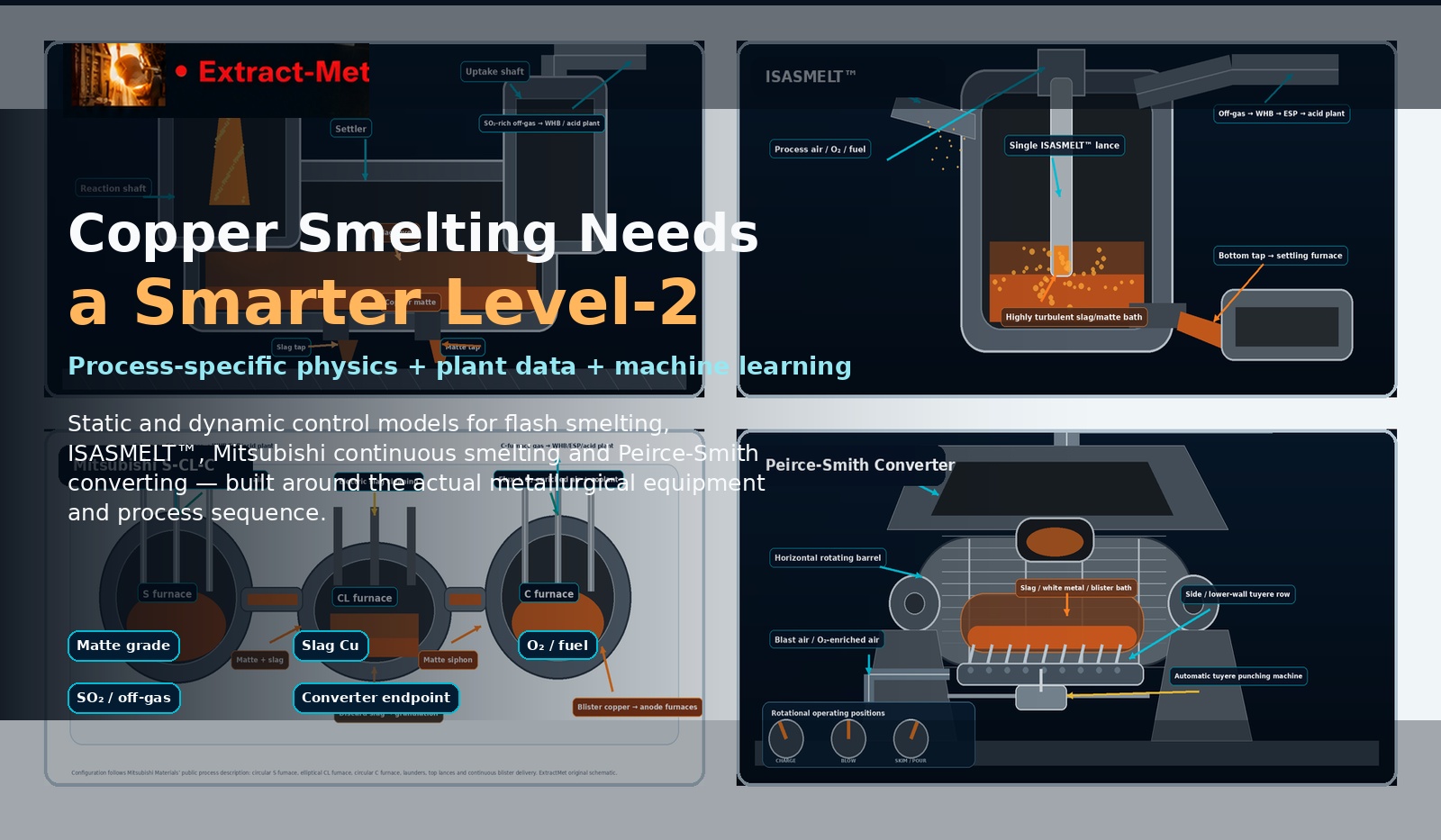
Copper Smelting Has a Data Problem: Why Furnaces and Converters Need a Smarter Level-2
Hybrid first-principles + machine-learning process control for flash smelting, ISASMELT™, Mitsubishi continuous smelting and Peirce-Smith / flash converting.
By Dr. Ajay Kumar Shukla · ExtractMet Private Limited
Copper smelting is already one of the most intensively instrumented operations in non-ferrous metallurgy. Feed rates, oxygen, enrichment, fuel, temperatures, pressures, gas analysis, matte assays, slag assays, converter events and acid-plant conditions may all be recorded. Yet the most important variables for operating decisions are often only partly measured, delayed or inferred after the fact.
The real opportunity is therefore not another dashboard. It is a Level-2 process-intelligence layer that continuously answers three questions: What is the true metallurgical state now? Where is the process heading? What operating action is most likely to move it toward the desired matte, slag, blister, throughput, energy and gas-handling targets?
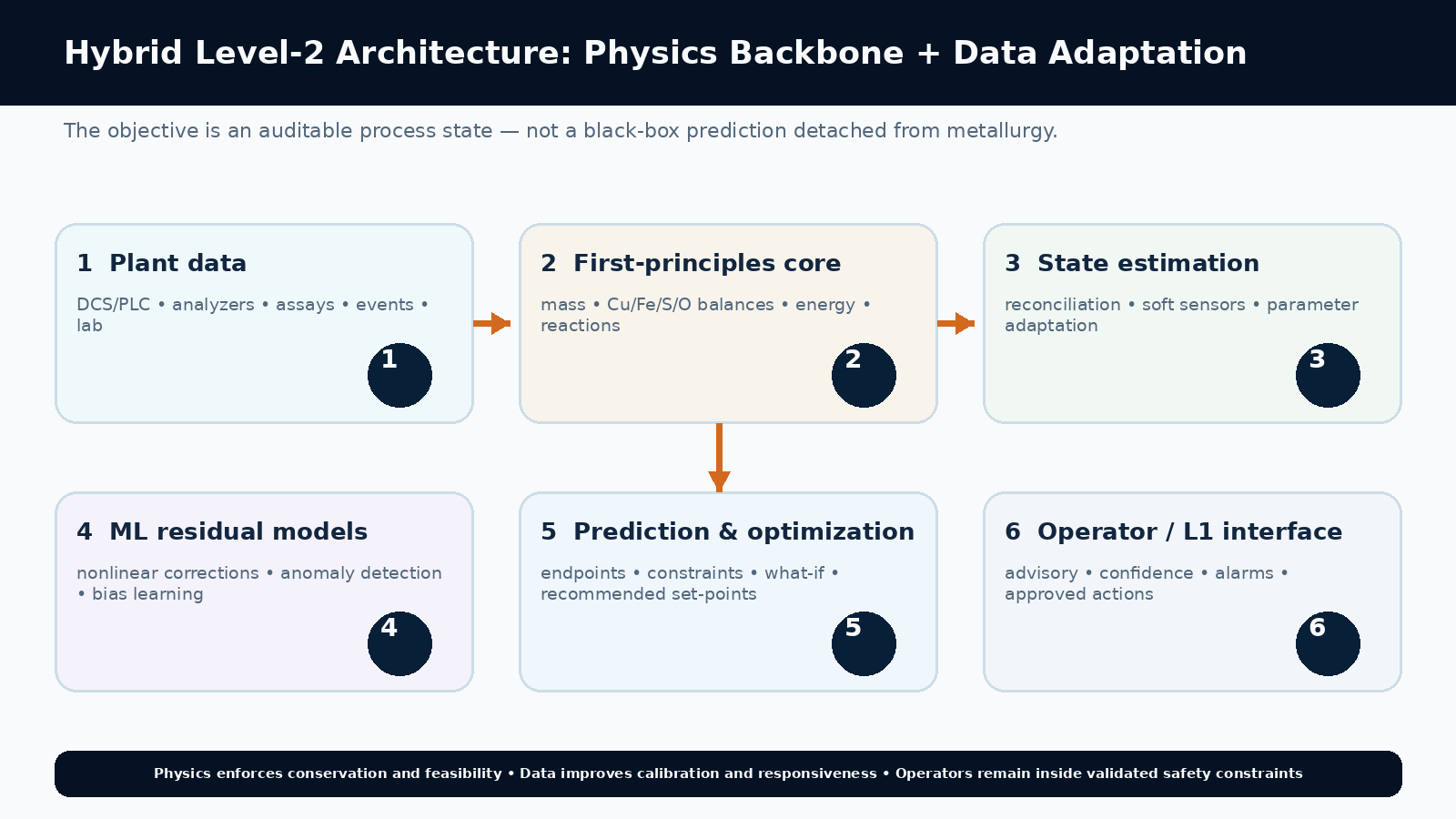
For copper smelters, a particularly practical route is a hybrid model: first-principles mass, elemental and energy balances provide the auditable backbone; plant data, soft sensors and machine learning adapt the model to the actual furnace, feed and campaign. The result can begin as an offline engineering tool and evolve into a dynamic operator-advisory or Level-2 system.
Start a project discussion with ExtractMet →
Different furnace technologies — the same control challenge
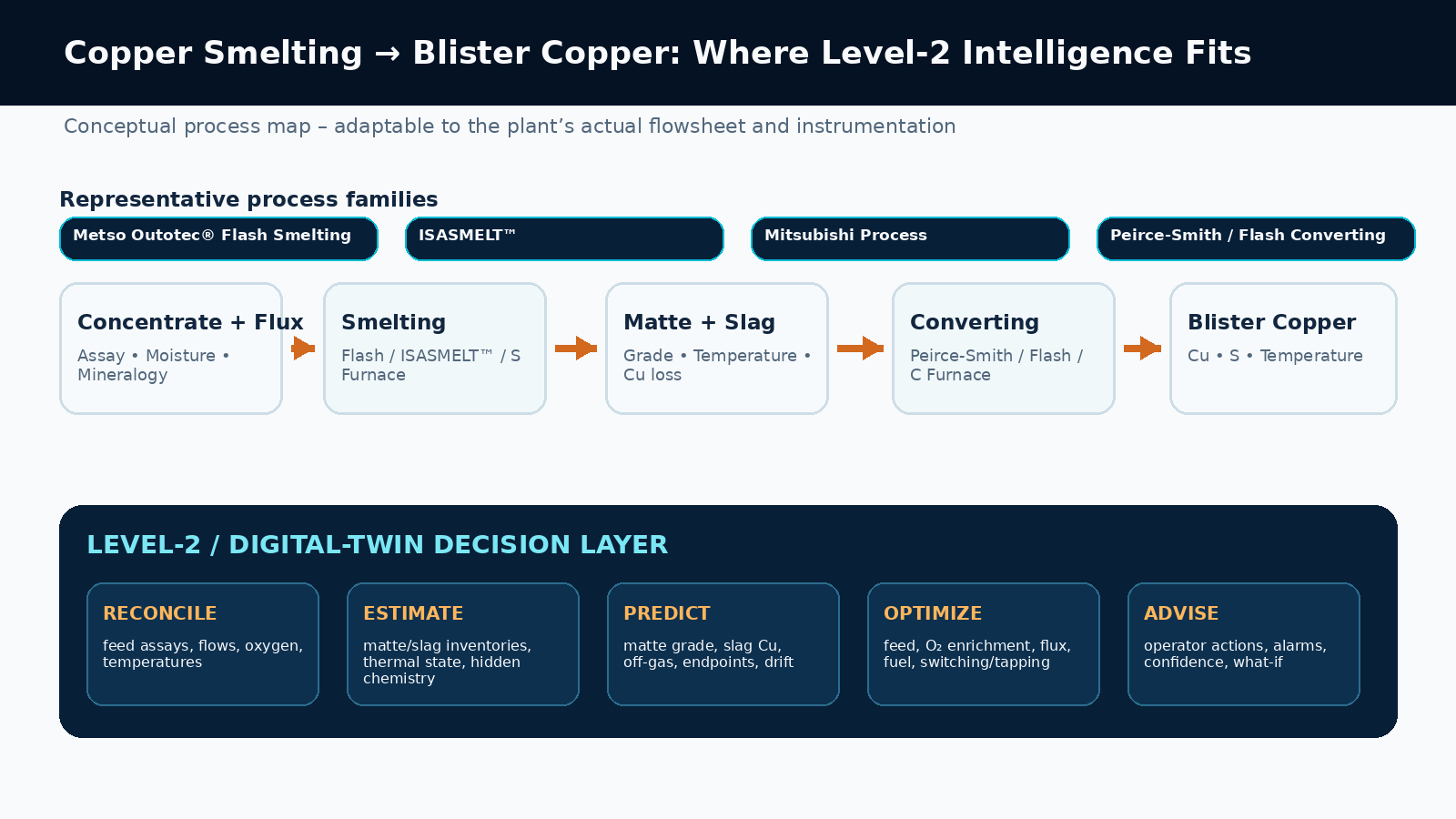
Modern copper-smelting routes are not identical, so a useful Level-2 system should never be a generic template. It must reflect the real flowsheet, vessel inventories, reaction sequence, gas handling, instrumentation and operating constraints.
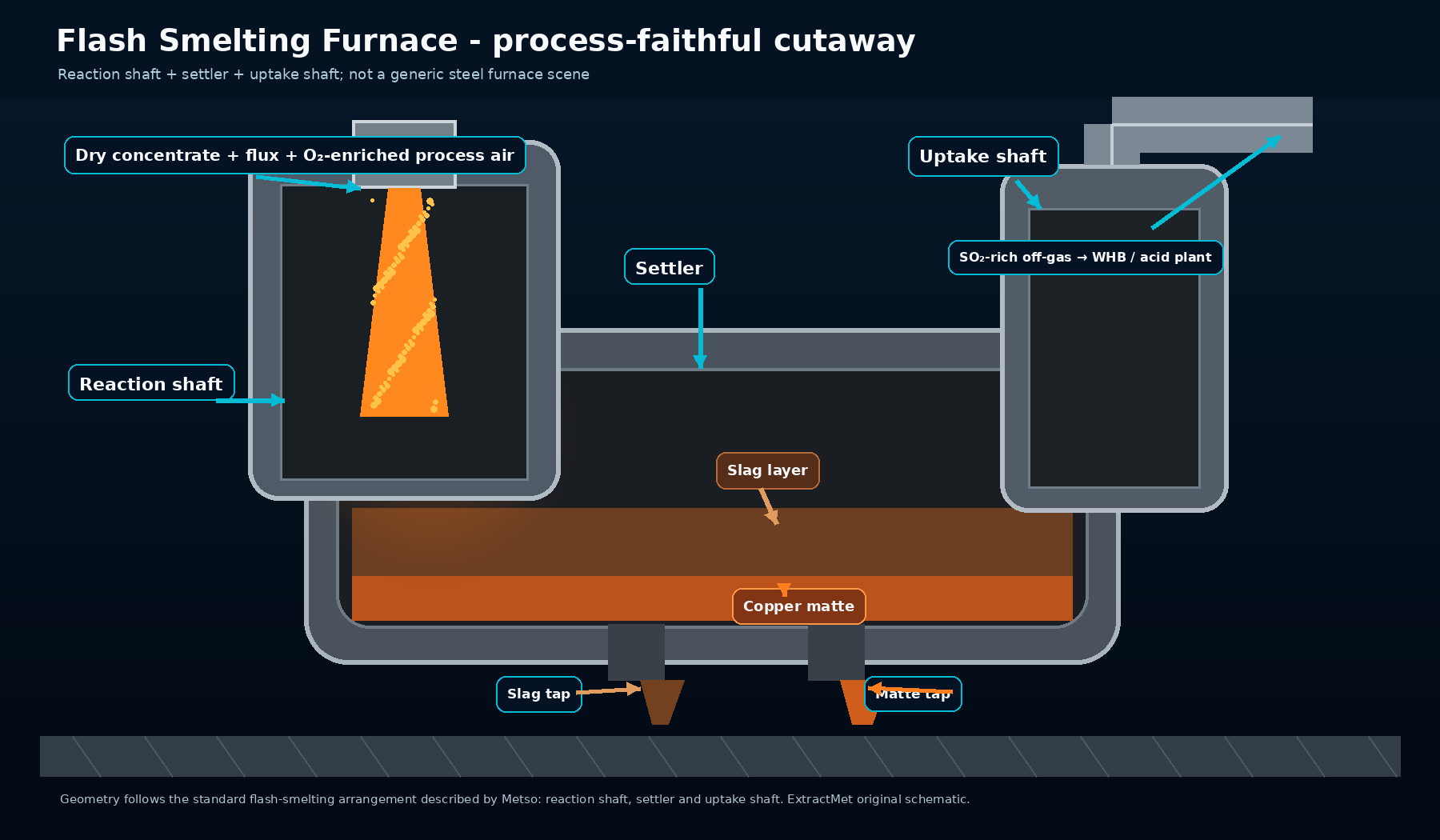
Metso’s Outotec® Flash Smelting Process uses the chemical energy of sulfide concentrate in a highly autogenous reaction system. From a control perspective, feed composition, dry feed rate, oxygen enrichment, reaction heat, matte grade, slag chemistry, dust and the strength and volume of the SO₂-bearing gas stream are tightly coupled.
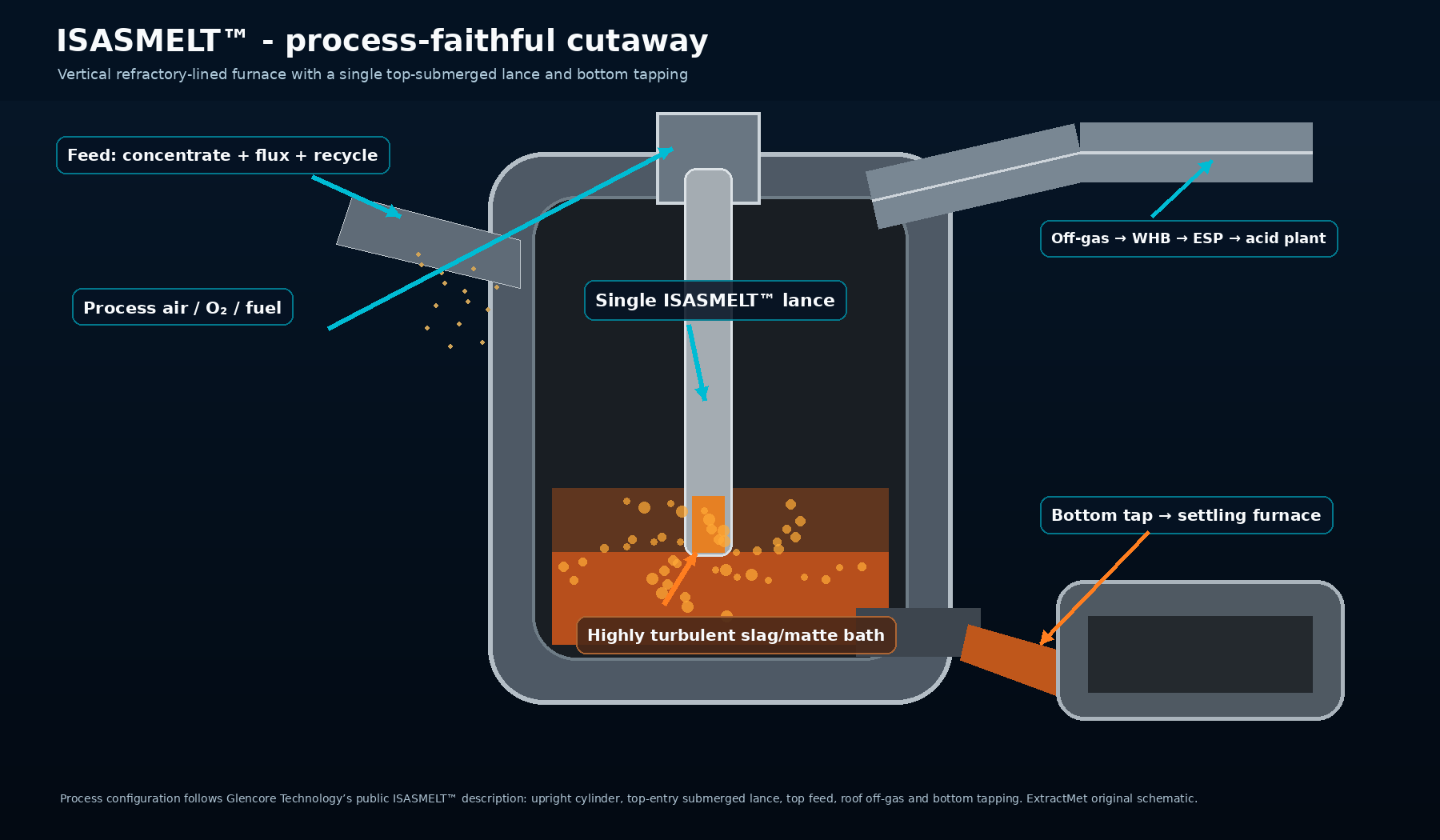
ISASMELT™ is a high-intensity top-submerged-lance bath-smelting process. Its dynamic behaviour depends on feed and oxygen delivery, lance and bath conditions, reaction intensity, slag state, thermal balance and downstream handling. A plant-specific model therefore needs both bath-level thermochemistry and data-driven adaptation to operating practice.
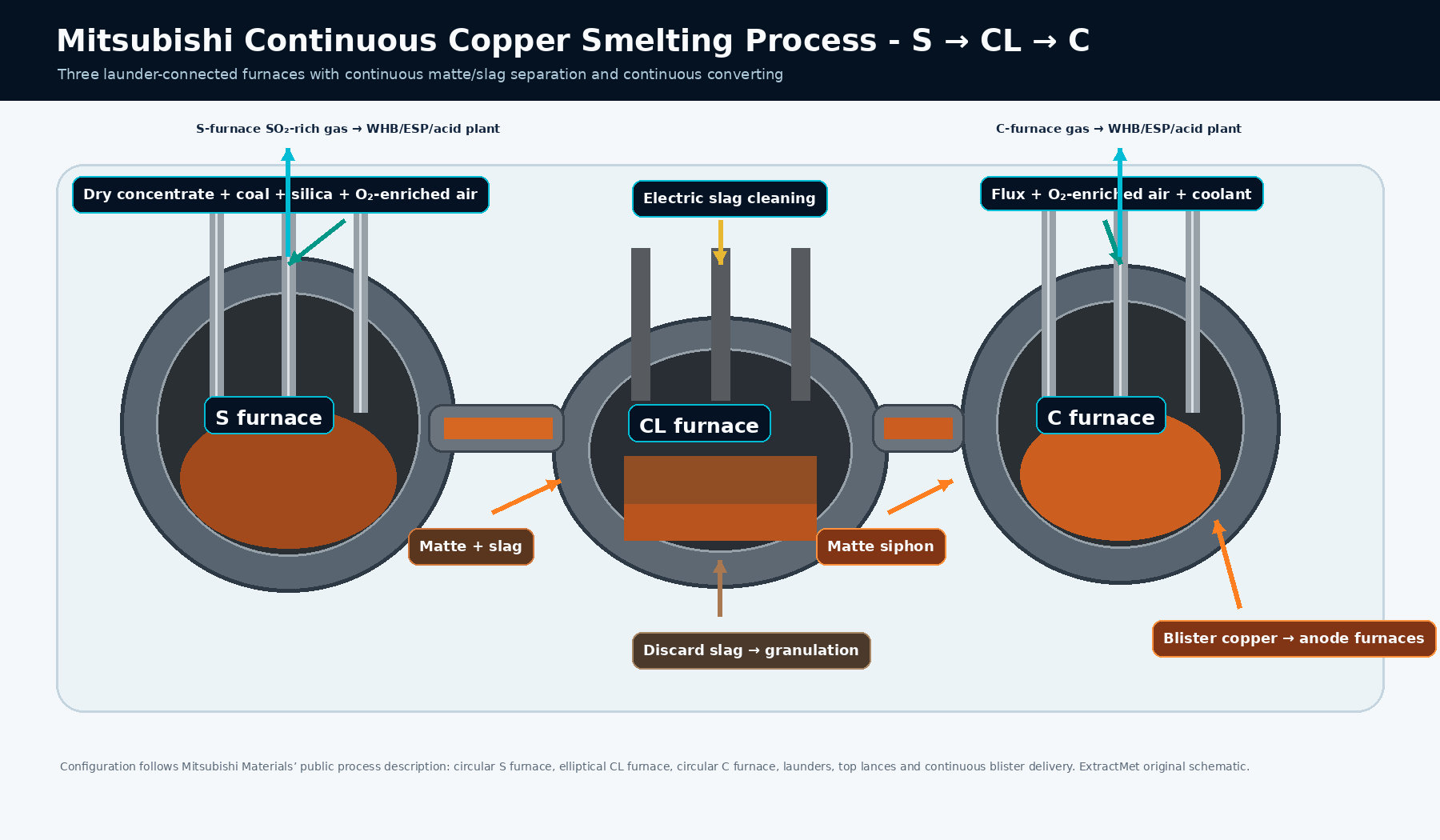
The Mitsubishi Continuous Copper Smelting and Converting Process links an S furnace, CL furnace and C furnace by launders. That continuity creates a different control problem: disturbances in feed, matte grade, slag separation or oxygen practice can propagate through connected inventories. A dynamic model can explicitly track those coupled states rather than treating each furnace as an isolated box.
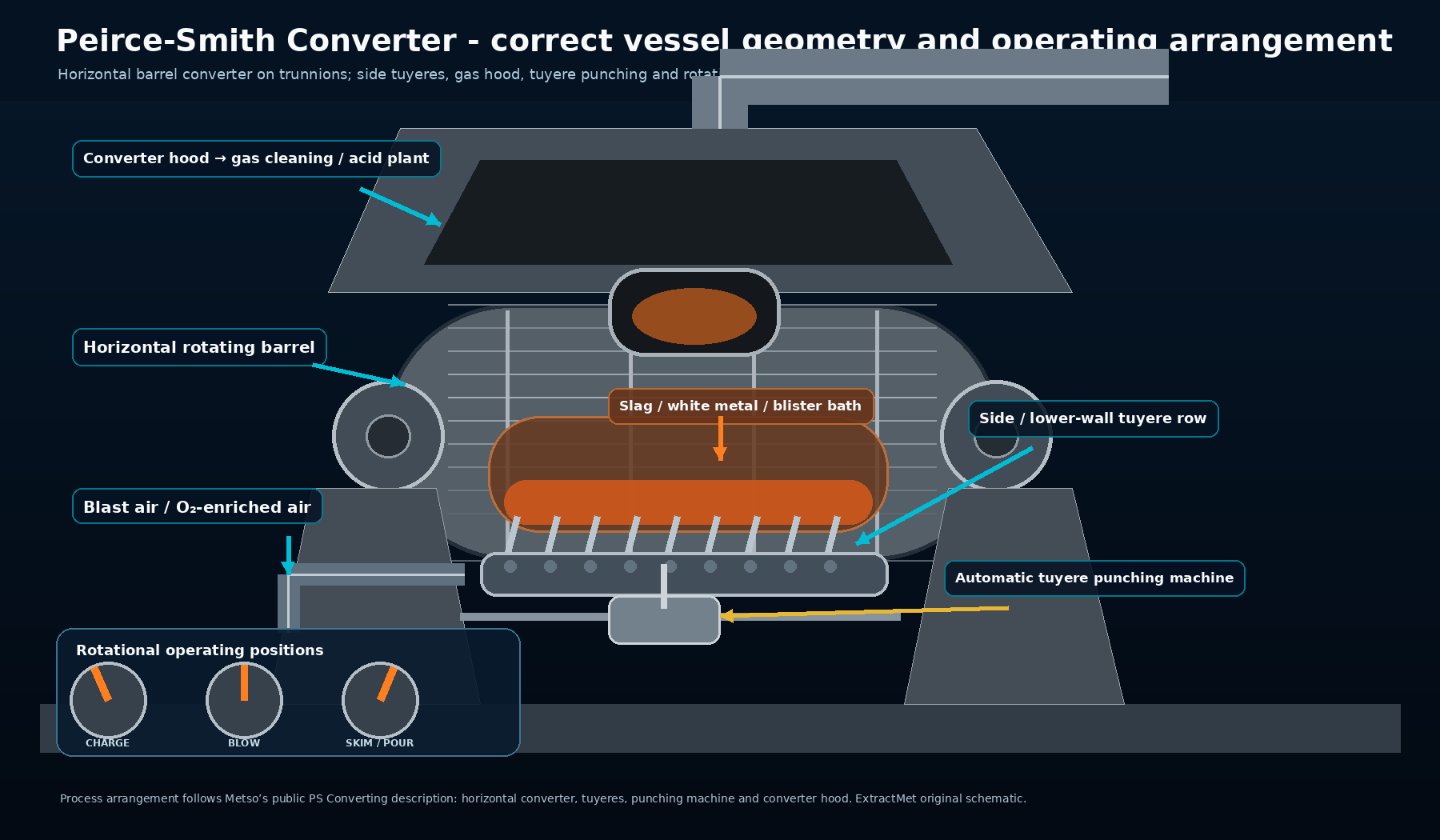
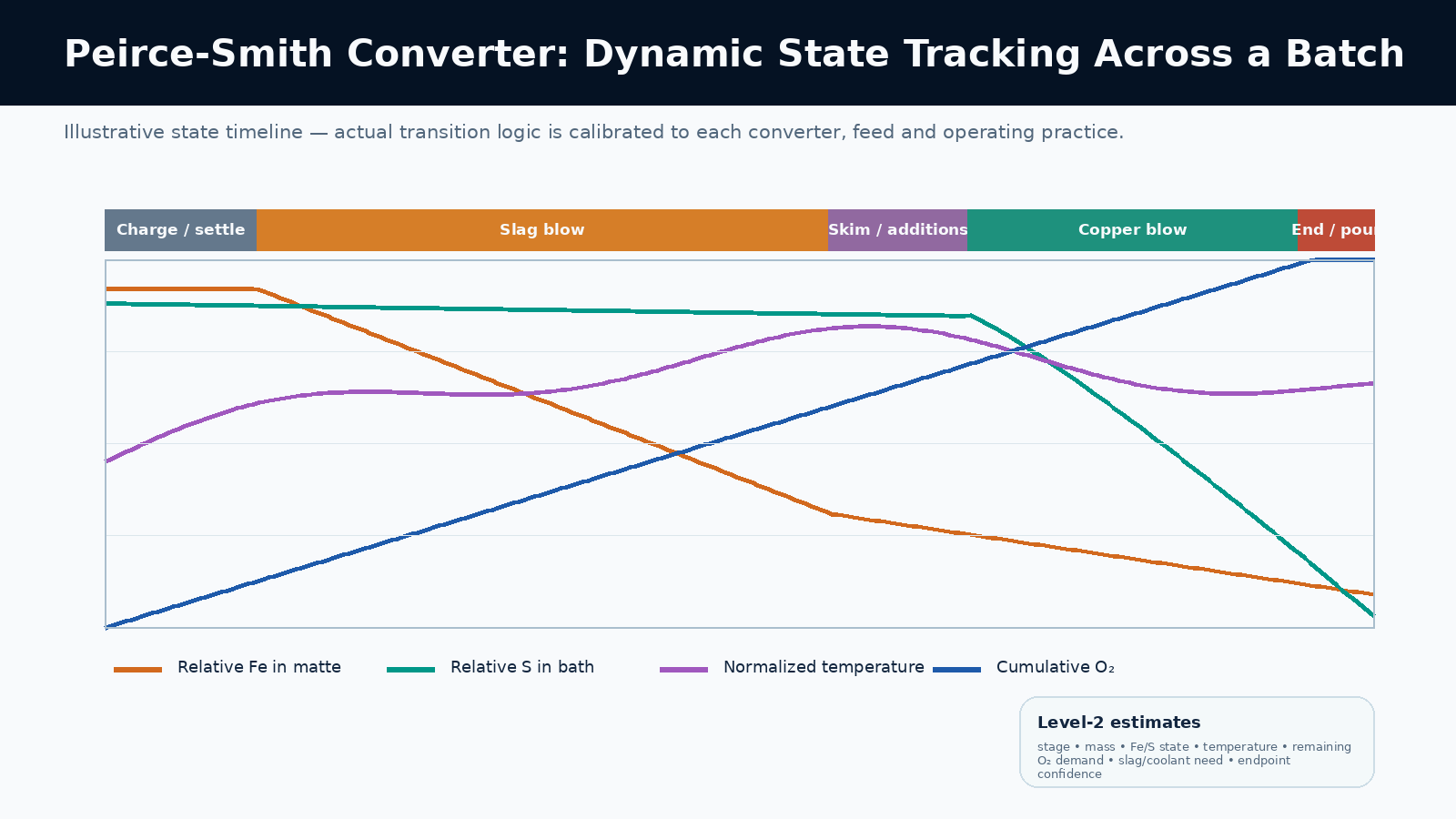
Peirce-Smith converting remains a major route for producing blister copper. The batch normally moves through a slag blow and a copper blow, with changes in bath composition, slag formation, oxygen demand, temperature, coolant/revert additions and gas evolution. The transition between stages and the final endpoint are exactly the kind of partially observed, time-dependent decisions where dynamic mass-and-heat-balance models add value.
Why first-principles models should remain at the core
A copper-smelting model has to respect conservation. Copper cannot disappear because a regression says so. Sulfur removed from matte must report to gas, slag or another defined stream. Iron oxidation changes slag formation and oxygen demand. Heat released by oxidation, heat carried by feeds and gases, furnace losses and sensible heat of products must reconcile with the predicted thermal state.
That is why the physics core should explicitly calculate, as appropriate to the process, total mass balance; Cu, Fe, S, O and gangue/flux balances; matte and slag production; oxidation and sulfide-reaction stoichiometry; oxygen demand and utilization; fuel/combustion contribution; sensible and reaction heats; off-gas flow and composition; dust/revert recycle; and product temperature.
For a plant team, this transparency matters. When a model recommends a change in oxygen, feed, flux, coolant or switching time, engineers should be able to see the metallurgical reason behind the advice — not just a probability score.
Where machine learning adds value — without replacing metallurgy
First-principles models are necessary, but they are never perfect. Heat losses change with campaign age and shell condition. Assays arrive late. Flowmeters drift. Dust carry-over and slag copper can be difficult to predict from equilibrium assumptions alone. Feed mineralogy influences kinetics and partitioning in ways that are not fully captured by a compact online model.
Machine learning is most valuable when it learns these residuals and hidden relationships while remaining constrained by the metallurgical model. Examples include soft sensors for matte grade or slag copper between laboratory samples; adaptive correction of heat-loss or oxygen-utilization parameters; prediction of abnormal gas behaviour; bias detection for analyzers and flow measurements; estimation of transition timing in converter blows; and early warning of operating states associated with poor recovery, unstable temperature or gas-handling excursions.
This hybrid structure is also easier to maintain. If feed chemistry moves outside the historical data envelope, the conservation equations still provide a physically meaningful backbone. If the plant later changes a burner, lance, feed blend or operating target, the physics can be updated explicitly and the data-driven layer retrained around the new regime.
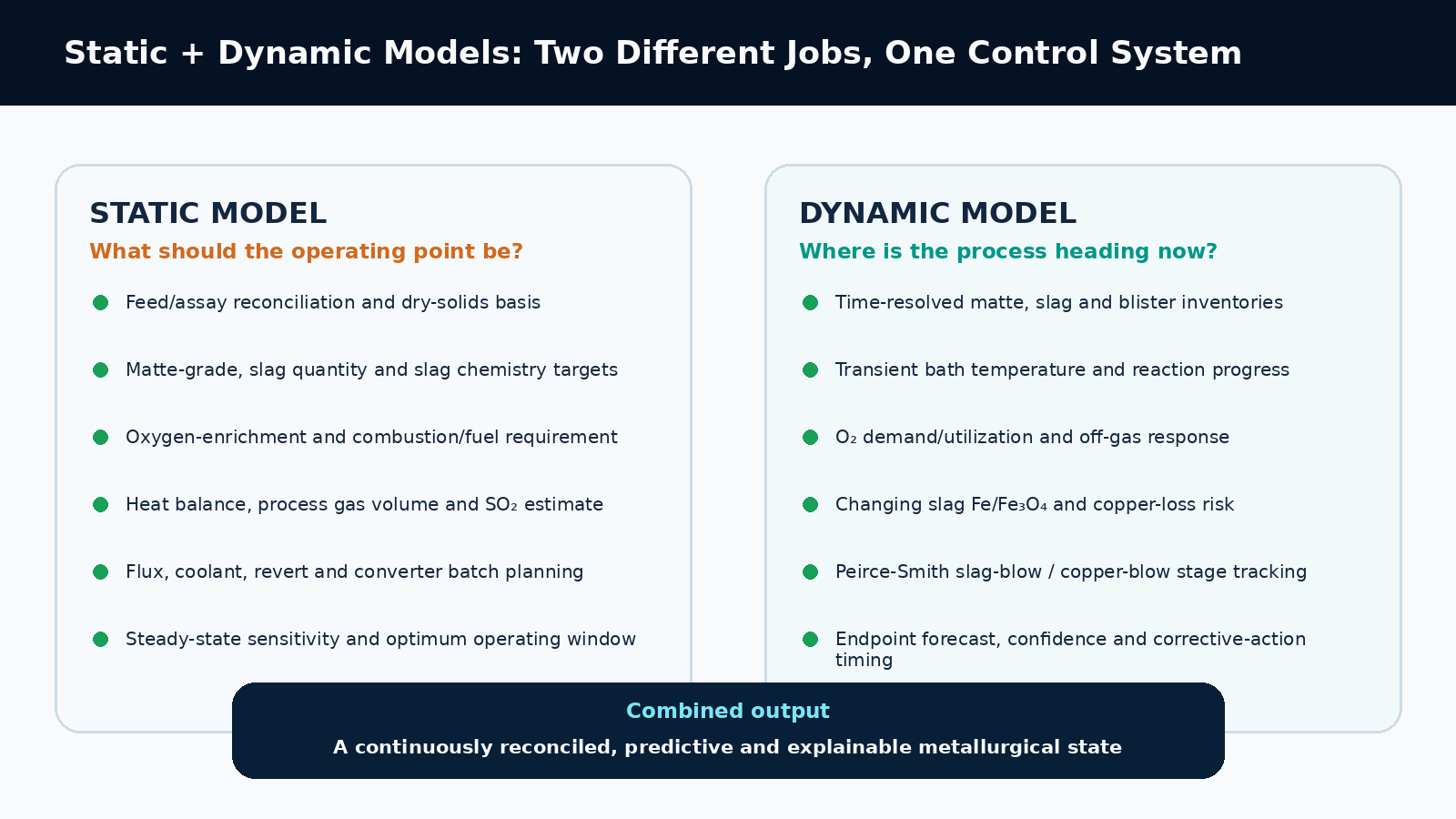
Static models answer “what should we target?”
A static or quasi-steady model is the right tool for planning and reconciliation. Before or during production it can calculate a consistent operating point from feed assays, target matte grade, flux practice, oxygen enrichment, fuel availability and product constraints.
Typical static-model outputs can include predicted matte and slag rates; matte Cu/Fe/S state; slag quantity and Fe/SiO₂ or other plant-relevant indices; oxygen and enrichment requirement; external-fuel or autogenous-margin estimate; off-gas flow and SO₂ concentration; dust/recycle terms; converter silica, coolant and revert planning; blister mass and expected residual sulfur; and sensitivity to concentrate blend or throughput.
For commercial decision support, the static model is also useful for what-if studies: “What happens if concentrate sulfur falls?”, “How much extra oxygen is needed for this feed blend?”, “What matte grade minimizes downstream bottlenecks?”, or “How will a higher impurity feed affect the gas and slag load?”
Dynamic models answer “where is the process heading?”
A dynamic model adds time and inventory. Instead of assuming that the furnace is at steady state, it tracks how material and energy accumulate, react and leave the vessel. This is critical during feed-rate changes, furnace transitions, tapping, converter stage changes, abnormal events and other periods where a steady-state snapshot is misleading.
For smelting, a dynamic model can track matte/slag inventories, bath or settler thermal state, reaction progress, oxygen demand, off-gas response and the propagation of feed disturbances. For a Peirce-Smith converter it can track slag-blow and copper-blow progression, Fe and S removal, slag generation, temperature, remaining oxygen demand, coolant/revert capacity and endpoint confidence.
The most important distinction is practical: the static model recommends the target operating window; the dynamic model tells the operator whether the actual process is moving toward or away from that window.
A Peirce-Smith converter is a strong use case for dynamic advisory
Converter operation is a particularly clear example of why Level-2 modelling matters. The operator sees air flow, gas response, time, vessel events and laboratory information, but the instantaneous bath composition and remaining reaction demand are not continuously measured. Stage transitions are therefore partly based on experience and indirect signals.
A dynamic converter twin can integrate matte charge and assays, silica/revert/coolant additions, blast flow and oxygen enrichment, off-gas analysis, temperature measurements and event history. The model can maintain a running estimate of bath mass, Fe/S state, slag quantity, temperature and remaining oxygen demand, then forecast the likely time or oxygen quantity to the next decision point.
This is not a speculative direction for the industry. Metso has publicly described a PSC Advisor that combines a dynamic mass-and-heat-balance model with plant sensor and laboratory information to help standardize operation, predict endpoints and optimize revert charging. The broader lesson is important: copper converting is well suited to model-based, plant-data-calibrated operator advisory.
High-value Level-2 applications for a copper smelter
- Matte-grade prediction and control: reconcile concentrate assay, oxygen and reaction progress to maintain the desired matte target.
- Slag copper soft sensing: combine mass balance, slag chemistry, temperature, settling conditions and historical plant data to estimate Cu-loss risk before the next assay.
- Oxygen-enrichment and fuel advisory: quantify oxygen demand, thermal margin and the effect of feed composition or throughput changes.
- Off-gas and acid-plant coordination: predict gas volume and SO₂ strength so smelting decisions consider downstream gas-handling constraints.
- Concentrate blend and throughput optimization: compare alternative blends against matte, slag, energy, gas and downstream-converter constraints.
- Converter stage and endpoint prediction: estimate remaining Fe/S removal, oxygen demand, coolant/revert requirement and switching/end-point timing.
- Dust, recycle and revert reconciliation: close the metallurgical balance and identify systematic losses or inventory mismatches.
- Abnormal-condition detection: identify sensor drift, heat-loss changes, unstable reaction regimes or deviations from historically safe and productive operating windows.
What the operator should see
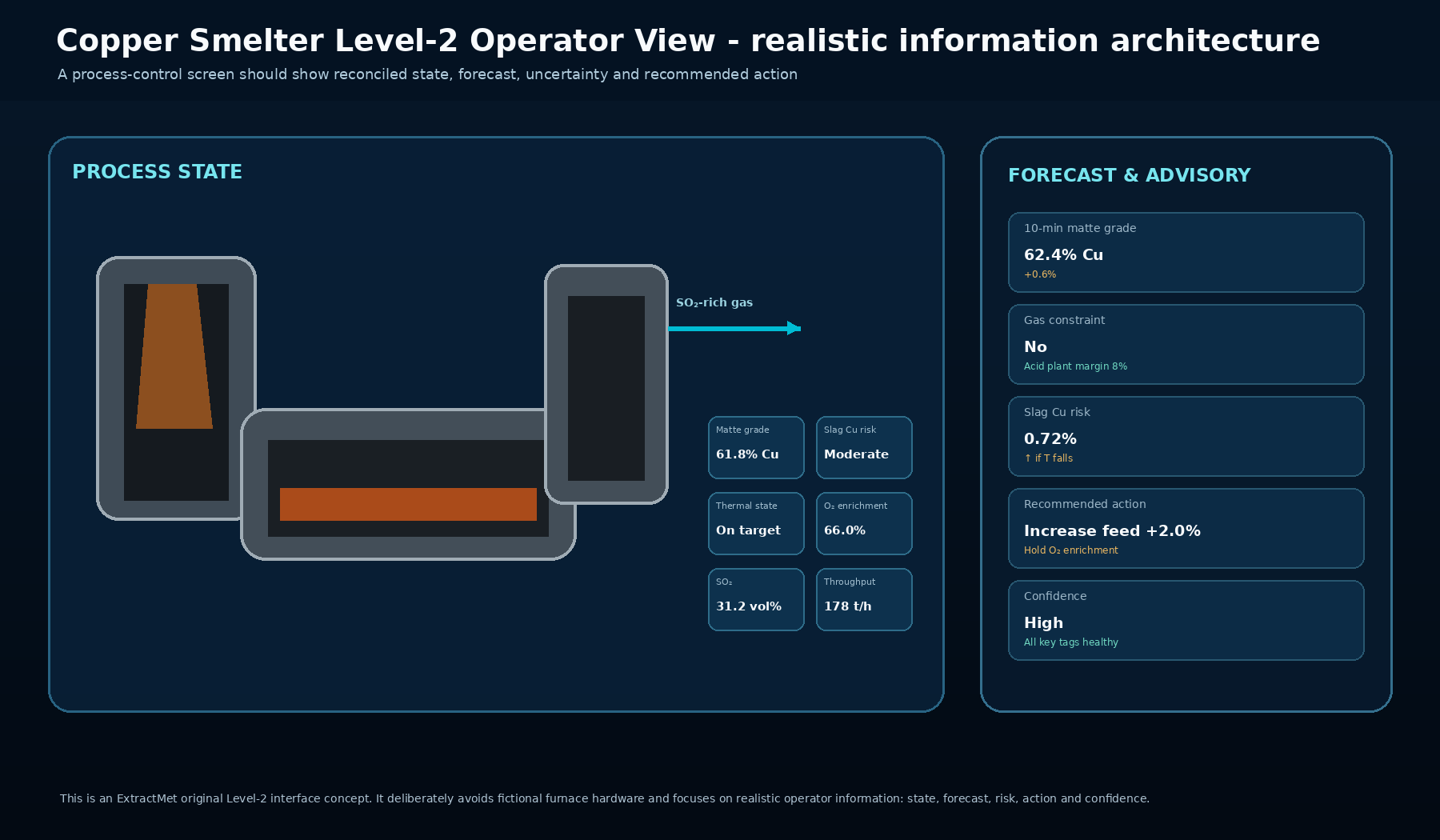
A good Level-2 interface should be simpler than the model behind it. The operator does not need hundreds of equations on screen. The useful view is a small number of trusted states and decisions: current matte grade estimate; current temperature and thermal margin; slag copper risk; oxygen remaining; expected next endpoint; gas-strength forecast; recommended feed/oxygen/flux/coolant action; confidence or uncertainty; and the reason for the recommendation.
The system should also support replay. When a heat, blow or campaign performs poorly, engineers should be able to reconstruct the model state and see which feed change, measurement, event or parameter caused the deviation. That turns the Level-2 system into a learning platform rather than a one-way automation layer.
How to build it with lower implementation risk
- Diagnose one measurable decision problem. Examples: matte-grade variability, high slag Cu, converter endpoint scatter, oxygen inefficiency or unstable gas to the acid plant.
- Audit the data. Map DCS/PLC tags, sample timing, laboratory assays, event logs, analyzers, calibration history, material accounting and known sensor weaknesses.
- Build the first-principles model. Establish the mass, elemental, thermochemical and inventory structure before adding machine learning.
- Calibrate and validate. Test across feed blends, throughput ranges, campaigns, shifts and abnormal events — including unseen historical data.
- Add soft sensors and ML where they create measurable value. Use them for residual learning, parameter adaptation and hidden-state estimation rather than replacing conservation equations.
- Deploy in shadow mode. Run the advisory beside the existing operation, measure accuracy and KPI impact, and collect operator feedback without changing control automatically.
- Integrate only after proof. Move toward Level-1/Level-2 interfaces, closed-loop optimization or broader plant-wide coordination only when the model has demonstrated reliability and governance.
The business case should be measured, not promised
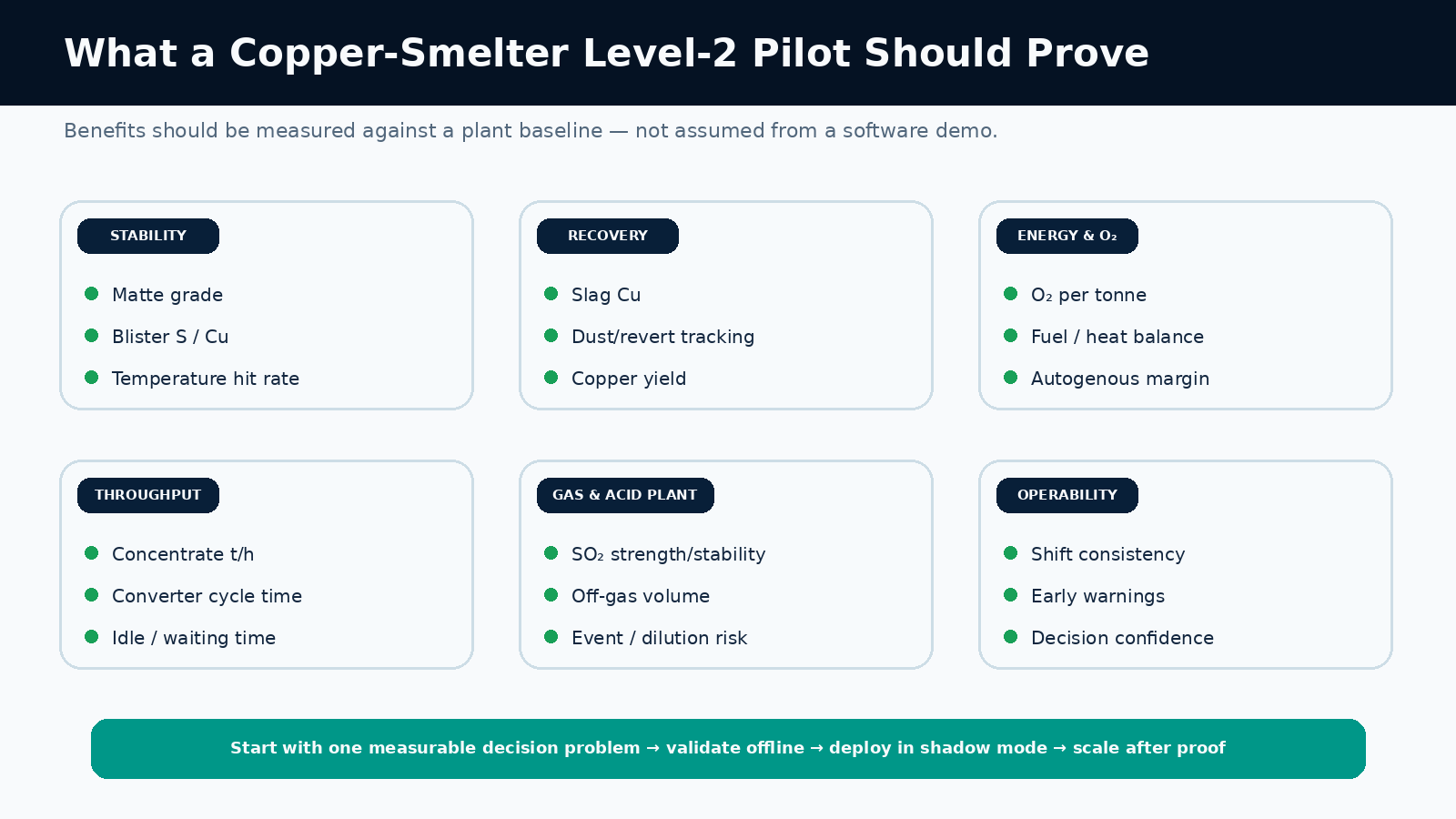
The economic value of advanced control is plant-specific. It depends on current variability, feed constraints, instrumentation, capacity utilization, gas-handling bottlenecks, recovery losses and the degree to which operators can act on the recommendations. Any vendor that starts with a guaranteed percentage saving before examining the plant is starting in the wrong place.
A credible pilot instead defines the baseline and the metrics. For a copper smelter these may include concentrate throughput; matte-grade standard deviation; slag Cu; blister sulfur and temperature hit rate; oxygen per tonne; fuel or auxiliary-energy intensity; SO₂ strength and gas-volume stability; converter cycle time; revert/coolant usage; refractory or tuyere-related events; and shift-to-shift consistency.
The first goal is not full automation. It is to prove that a model can improve one important decision, explain its reasoning and work reliably across real plant conditions.
Where ExtractMet fits
ExtractMet Private Limited develops plant-focused metallurgical process models, digital twins, optimization tools and advanced process-control concepts. The working philosophy is physics first, plant calibration second: start from mass, elemental and heat balances, reaction thermodynamics and process logic; then combine them with data reconciliation, soft sensors, machine learning and optimization where those methods add value.
For copper smelting and converting, this approach can be configured around the actual plant route — flash smelting, ISASMELT™, Mitsubishi continuous smelting/converting, Peirce-Smith converting, flash converting, or a site-specific combination — rather than forcing the operation into a generic software template.
A project can begin as an offline static model, a dynamic campaign/batch simulator, a historical replay tool or a targeted soft sensor. After validation it can evolve into an operator-advisory Level-2 application integrated with the historian, LIMS and automation architecture.
If your copper smelter is trying to improve matte-grade consistency, reduce copper losses to slag, optimize oxygen and fuel, stabilize gas to the acid plant, improve converter endpoint control or build a digital-twin roadmap, the most useful starting point is one measurable operating problem.
Bring ExtractMet the process question, available data and plant constraints. We can help frame the model, build the metallurgical backbone, calibrate it against plant history and convert it into a practical validation and deployment pathway.
Start a project discussion with ExtractMet →
Suggested references and further reading
- Metso — Outotec® Flash Smelting Process
- Metso — Flash Converting Process
- Metso — Peirce-Smith Converting Process
- Metso — PSC Advisor for copper converting
- Mitsubishi Materials — Mitsubishi Process description
- Glencore Technology — ISASMELT™: How it works
- ExtractMet — Digital twins for metallurgical operations
- ExtractMet — Model catalogue
Explore ExtractMet: Digital twins · Model catalogue · Online demos · Discuss a project.
Technology note: Outotec®, ISASMELT™ and other process names are trademarks or technology names of their respective owners. ExtractMet is independent of those OEM/licensor organizations.