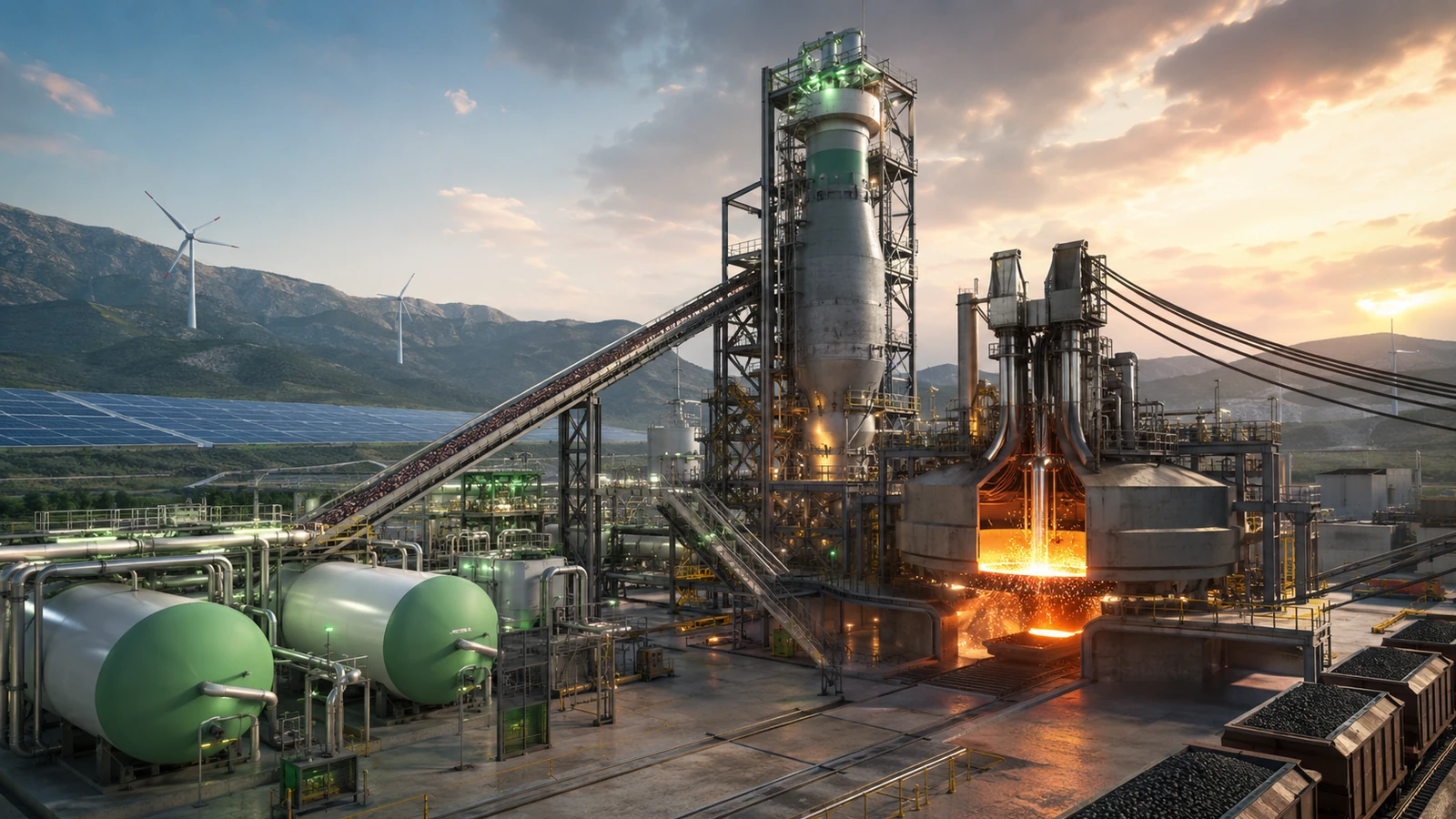
Steel companies are under pressure to decarbonize while still protecting throughput, quality, yield, refractory life, safety and customer delivery. That is the real challenge.
Green steel is not a single switch from coal to hydrogen. It is a sequence of difficult plant decisions: which route to adopt, which fuel to replace first, how much hydrogen to blend, how to use scrap or DRI, how to stabilize the furnace, how to prove the carbon number, and how to avoid losing production during the transition.
The global scale is large enough that every improvement matters. The World Steel Association reports that in 2024 the steel sector produced about 1,886 Mt of steel and emitted roughly 4.1 billion tonnes CO2e, representing about 7-8% of global anthropogenic greenhouse-gas emissions. The same source reports an average 2024 GHG intensity of 2.18 tCO2e per tonne of crude steel. The International Energy Agency has warned that steel-sector emissions must fall sharply over the coming decades to align with climate goals.
This is exactly where plant-specific process control and digital twins become powerful. A decarbonization roadmap can be written in a boardroom, but carbon reduction is delivered heat by heat, shift by shift and furnace by furnace.
ExtractMet works at this interface: process metallurgy, mathematical modelling, plant data, process control and digital-twin-enabled operator advisory for ironmaking and steelmaking plants.
Why green steel is an operating problem
Most decarbonization discussions focus on technology names: hydrogen DRI, scrap-EAF, electric smelting, biomass, carbon capture, oxygen enrichment, top-gas recycling, smelting reduction or renewable power. Those are important. But the plant manager's daily question is different:
A blast furnace may need better thermal-state control and gas-utilization logic before a major retrofit. A MIDREX or HYL-type DRI module may need reducing-gas and hydrogen-blending control before a hydrogen transition. An electric arc furnace may need dynamic charge-mix, oxygen, burner, carbon and foamy-slag optimization before renewable electricity creates full value. A rotary kiln DRI unit may need accretion warning, temperature-profile control and feed-quality correction before it can deliver stable low-carbon operation.
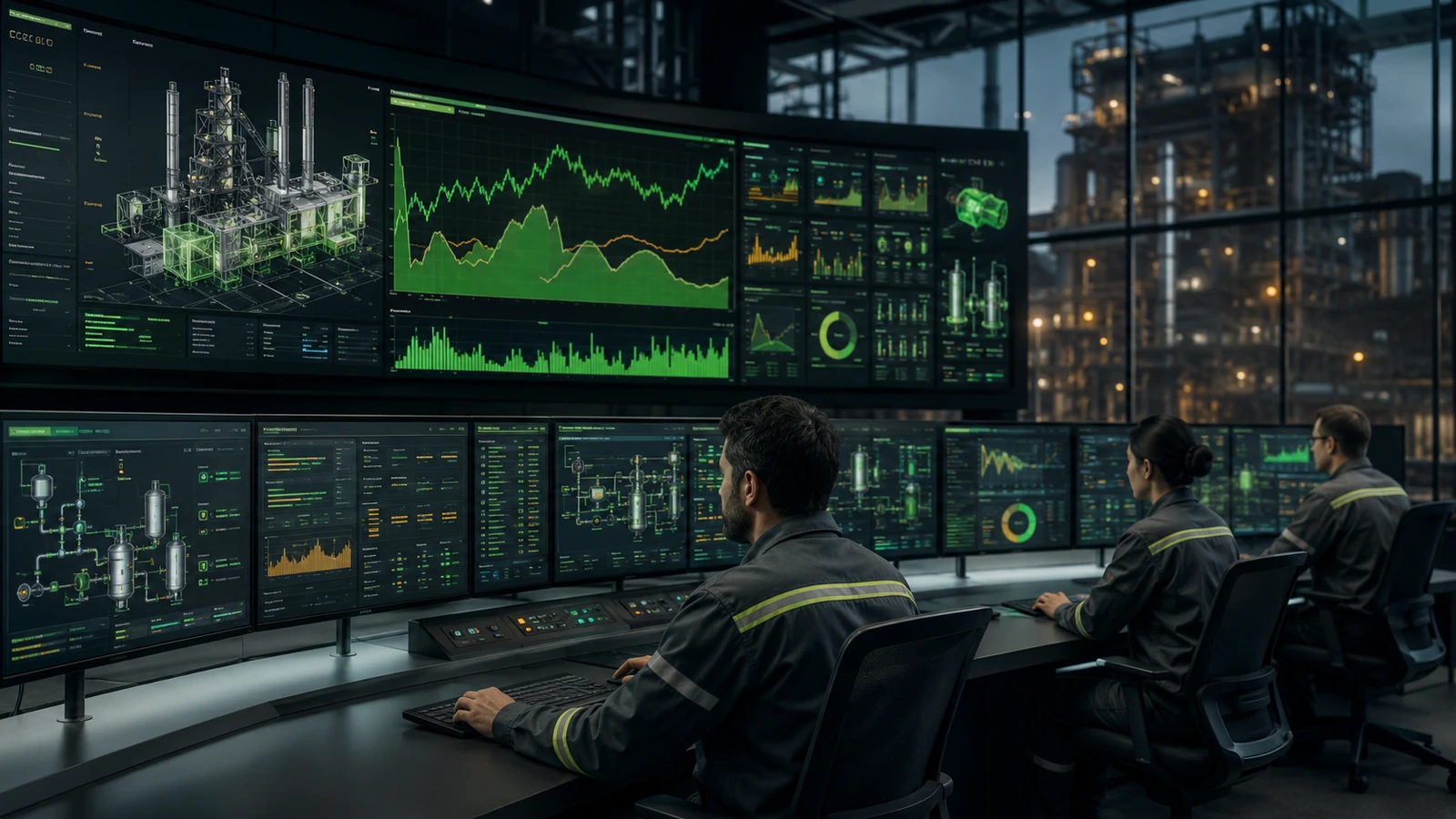
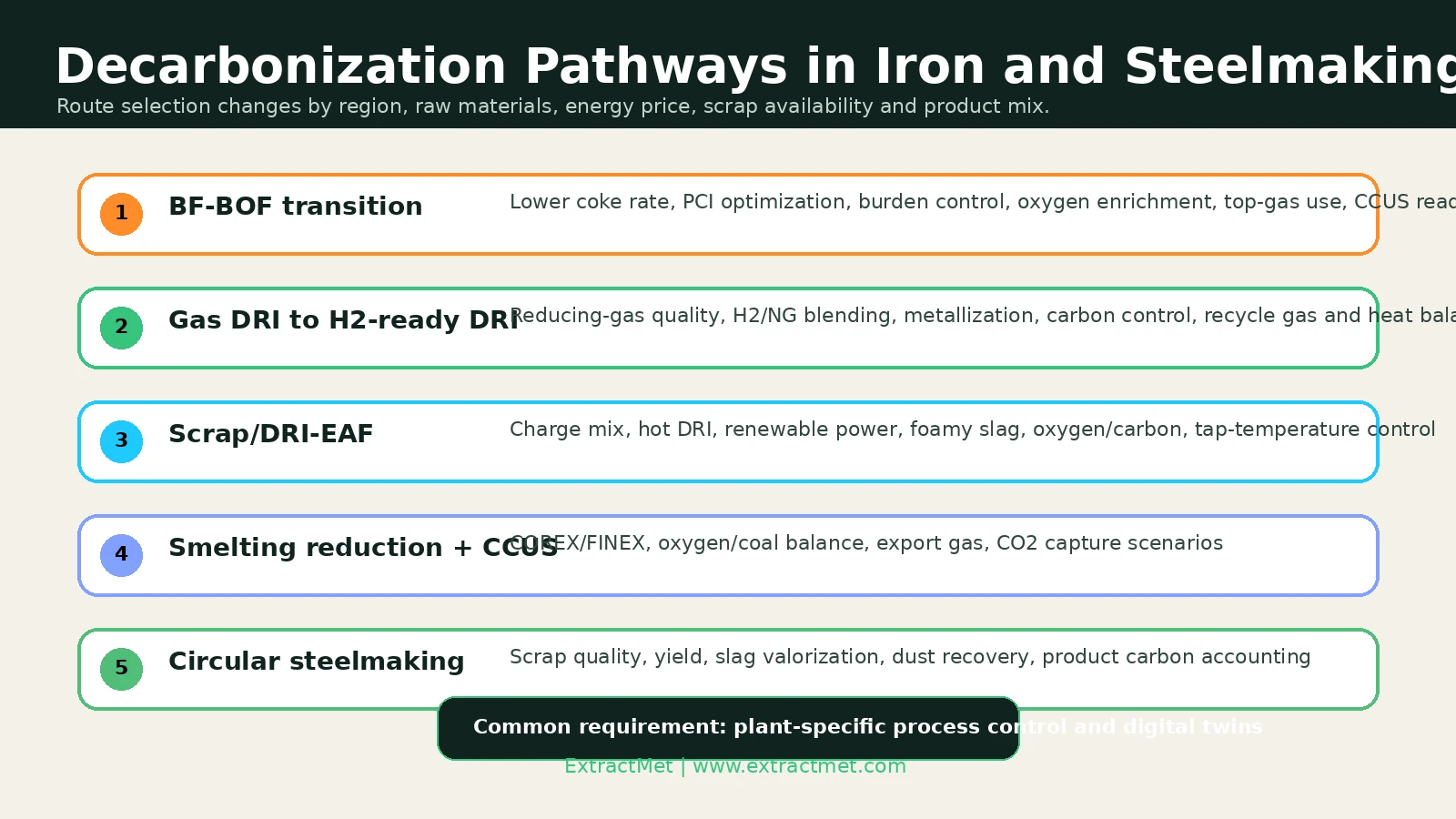
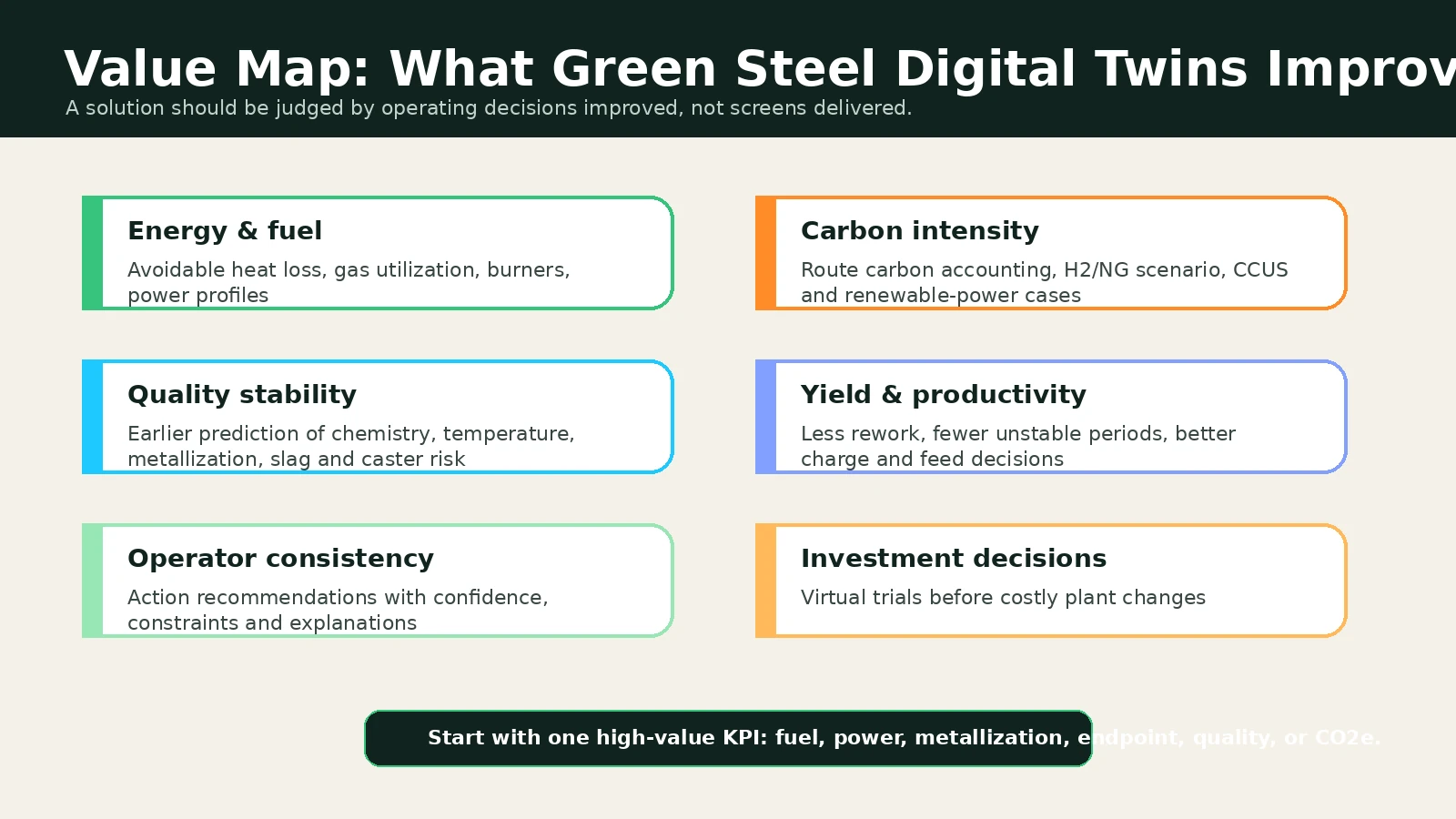
That is why digital transformation in green steel must go beyond dashboards. A dashboard shows what is measured. A digital twin estimates what is not directly measured and recommends actions that respect metallurgical constraints.
The hidden-state problem in low-carbon steel plants
Many important operating variables are invisible or measured too late. Examples include:
- The true thermal reserve and gas-utilization state of a blast furnace.
- The real-time reduction degree, carbon and temperature profile inside a DRI shaft furnace.
- The melting progress, slag state and chemical energy balance in an EAF.
- The endpoint carbon, temperature, FeO and yield risk in BOF steelmaking.
- The refining potential, superheat and inclusion-risk history in secondary metallurgy and casting.
- The actual heat-by-heat carbon intensity of the route, including power, fuel, metallics and gas networks.
A plant-specific digital twin can combine sensors, historian tags, laboratory chemistry, material tracking and first-principles balances to estimate these variables continuously. The value is not only visualization. The value is decision support: what-if analysis, early warning, operator guidance and carbon-aware optimization.
Decarbonization pathways need control logic
There is no single green steel route that fits every plant. India, Europe, the Middle East, Japan, Korea, Africa and North America face different combinations of ore quality, scrap availability, gas price, hydrogen price, renewable power, grid carbon intensity, product mix and existing assets.
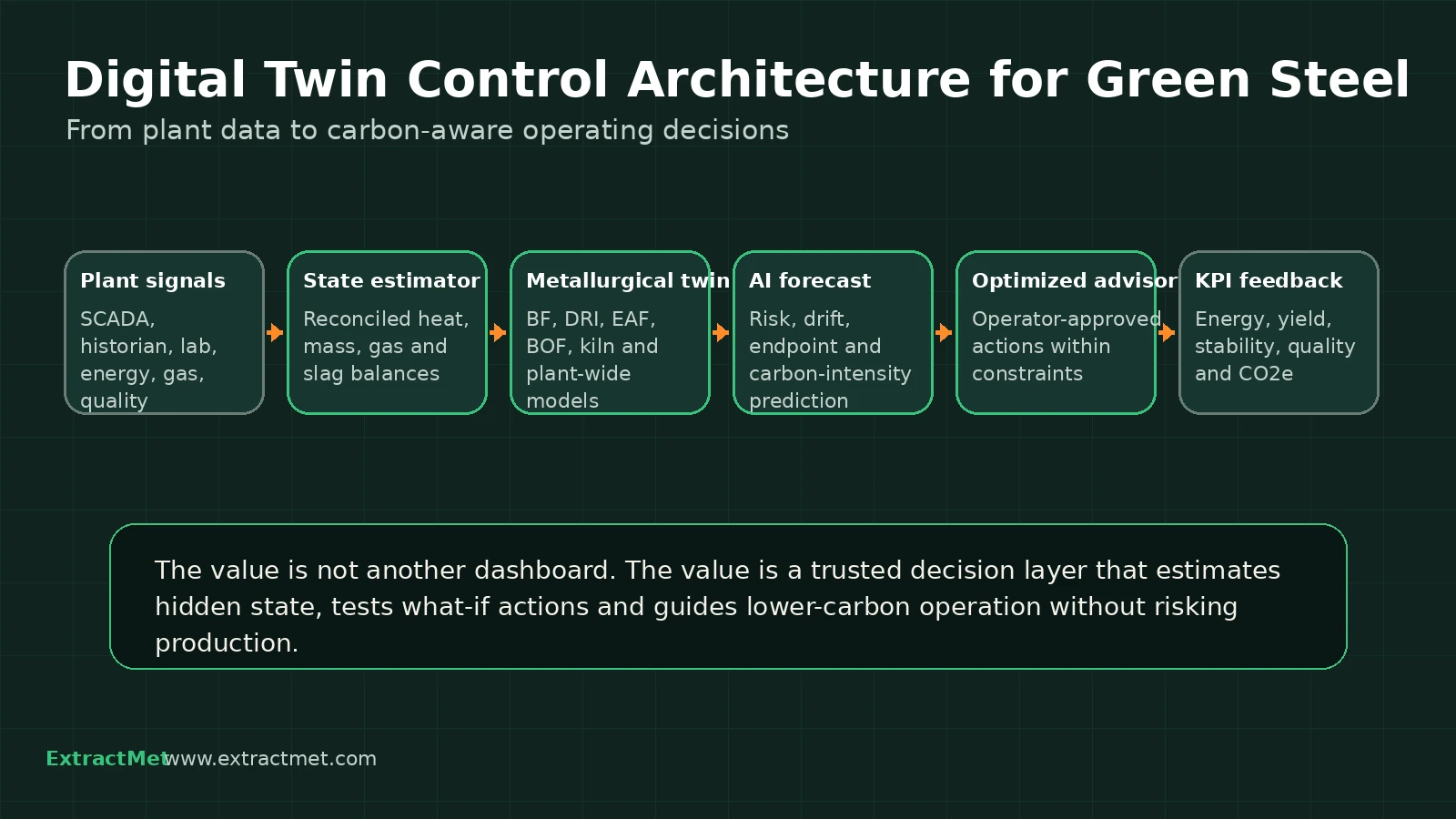
For that reason, ExtractMet frames sustainable iron and steelmaking as a portfolio of route-specific operating decisions:
BF-BOF transition
Optimize burden distribution, fuel rate, PCI, oxygen enrichment, hot blast, gas utilization, slag practice, hot-metal quality and CO2-capture readiness.
Gas-based and hydrogen-ready DRI
Control H2/CO ratio, bustle-gas temperature, reforming, recycle gas, metallization, DRI carbon and product temperature.
Scrap/DRI-EAF steelmaking
Optimize metallics, electrical and chemical energy, oxygen, carbon, slag foaming, tap temperature, yield and carbon intensity.
Rotary kiln DRI
Improve ore-coal feed control, air split, thermal profile, accretion risk, product metallization and carbon under variable Indian raw materials.
Plant-wide networks
Link process twins to power, gas, oxygen, steam, casting, rolling, yield and product-level carbon accounting.
Circular steelmaking
Improve scrap quality, material recovery, dust and slag valorization, yield, traceability and product carbon reporting.
What ExtractMet can build for clients
ExtractMet's offering is not a generic software screen. It is a plant-specific process intelligence layer designed around the metallurgy and the client's operating problem.
- Opportunity diagnostic. Identify where energy, carbon, productivity or quality losses occur and which decision offers the best return.
- Plant-specific heat and material balance. Build the core model for BF, DRI, EAF, BOF, rotary kiln, ladle or plant-wide operation.
- Soft sensors and state estimation. Estimate hidden variables such as reduction degree, bath temperature, slag state, gas utilization or endpoint risk.
- What-if simulator. Test hydrogen blending, oxygen enrichment, raw-material changes, charge mix, fuel profiles or production-rate changes before plant trials.
- Operator advisory. Provide recommended actions with confidence, operating constraints and expected KPI impact.
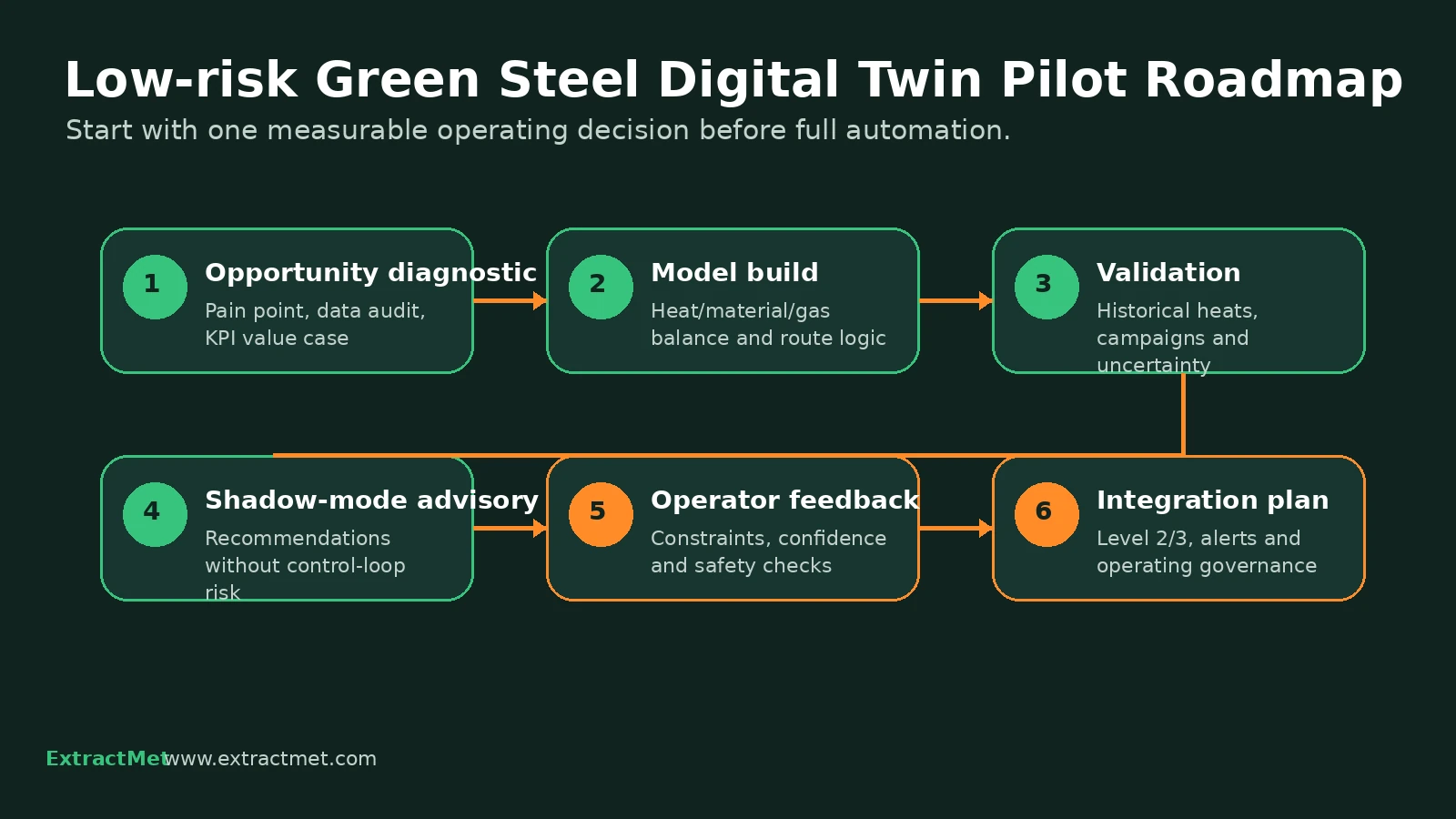
- Pilot-to-control pathway. Start in shadow mode, validate with plant data and integrate only when value and trust are proven.
Bring one measurable plant problem.
ExtractMet can help frame the decision, audit the available data, build a plant-specific model, validate it against operating reality and convert it into a practical advisory or process-control pathway.
High-value use cases for green ironmaking and steelmaking
1. Hydrogen blending advisor for DRI plants
Hydrogen injection or blending changes reduction kinetics, heat balance, gas utilization, metallization, DRI carbon and shaft temperature. The right question is not simply “How much hydrogen can we add?” It is “How much hydrogen can this plant use today while maintaining product quality and thermal stability?”
A DRI digital twin can estimate gas and solid conversion, predict metallization and carbon, and recommend operating windows for H2/NG blending, reformer load, recycle gas, oxygen addition and product temperature.
2. Low-carbon EAF charge-mix optimizer
EAF decarbonization depends on scrap, DRI/HBI, hot metal, pig iron, alloy additions, power, oxygen, burners, carbon injection and slag practice. A dynamic EAF twin can forecast melting progress, bath temperature, slag foaming and endpoint risk while tracking energy and carbon intensity per heat.
The commercial value is direct: lower kWh/t, lower tap-to-tap time, better yield, fewer corrections and clearer carbon reporting.
3. Blast furnace transition twin
Not every BF-BOF plant can shift immediately to hydrogen DRI. Many plants need a staged transition. A BF transition twin can help reduce fuel rate, improve top-gas utilization, diagnose thermal drift, evaluate burden and injection strategies, and test oxygen or alternative-fuel scenarios.
4. Rotary kiln DRI stability twin
In coal-based DRI, instability, accretion and raw-material variability can dominate both cost and emissions. A kiln twin can combine temperature profiles, shell temperature, ore and coal quality, feed rates, air split and product chemistry to provide early warnings and operating recommendations.
5. Plant-wide carbon-intensity model
A green steel claim must be backed by reliable data. Plant-wide models can reconcile material, energy, fuel, electricity, gas and product flows to estimate carbon intensity by route, campaign, heat, product family or customer order.
A practical implementation roadmap
Many plants delay digital transformation because they imagine a large, risky automation project. That is not necessary. The better route is phased.
Start with one repeated, expensive, measurable decision. Validate the model offline. Run recommendations in shadow mode. Compare model advice with operator action and actual outcome. Improve confidence. Only then integrate with control systems.
Good first-pilot targets
- Reducing-gas optimization and metallization prediction in DRI.
- Fuel-rate and thermal-state advisory in blast furnace operation.
- Charge-mix, power and oxygen strategy in EAF operation.
- Endpoint temperature and chemistry prediction in BOF operation.
- Rotary kiln accretion-risk warning and product-quality stabilization.
- Plant-wide carbon and energy accounting for green steel reporting.
What data is needed to begin
Most plants already have enough data to begin a diagnostic. The starting point is usually not perfect instrumentation; it is a clear operating question.
Useful data includes PLC/SCADA/historian tags, flow rates, pressures, temperatures, gas analysis, power, oxygen, fuel, feed rates, chemical analysis, shift logs, downtime history, quality data, production records and operating constraints.
The first deliverable should be a ranked list of use cases: expected value, data gaps, model scope, pilot cost, plant effort and deployment pathway.
Why ExtractMet
ExtractMet brings together metallurgical process knowledge, mathematical modelling, process optimization, control logic, digital twins, decarbonization strategy and practical plant-operating interpretation. The emphasis is plant-specific engineering, not cosmetic digitalization.
For steel plants, technology providers, EPC partners, industrial R&D teams and investors, this creates a useful starting point: a technically grounded way to evaluate and de-risk decarbonization pathways before committing to major plant trials or capital projects.
Bring us one measurable green ironmaking or green steelmaking problem:
- Excess fuel, power or gas consumption.
- Unstable metallization, hot-metal quality, bath chemistry or endpoint temperature.
- Hydrogen, scrap, DRI, oxygen, coal or charge-mix uncertainty.
- Need for carbon-intensity accounting and green steel reporting.
- Need to convert plant data into operator guidance.
Turn your decarbonization roadmap into operating results.
Discuss a diagnostic, digital-twin pilot, process-control model or plant-wide carbon-intensity system with ExtractMet.
Suggested LinkedIn teaser
Green steel is not only a technology transition. It is a control problem. Hydrogen DRI, scrap-EAF, BF transition, rotary kiln stability, plant-wide carbon accounting and green steel certification all need one common layer: a trusted process-intelligence system that turns plant data into operating decisions. Read the article and discuss a plant-specific pilot: https://www.extractmet.com/?utm_source=html&utm_medium=article&utm_campaign=green_steel_decarbonization
Sources and further reading
- World Steel Association: Climate change and the production of iron and steel
- World Steel Association: Sustainability Indicators Report 2025
- International Energy Agency: Iron and Steel Technology Roadmap
- International Energy Agency: Hydrogen Tracker
- Midrex Technologies: World DRI production reaches 140.8 Mt in 2024