
Your MIDREX Plant Has More Data Than Ever. Is It Helping You Make Better DRI?
How hybrid physics and machine learning models can turn operating data into practical guidance for gas-based direct reduction
By ExtractMet Private Limited
Compare the static/1D engineering model with the spatial 2D process-control model in the ExtractMet Online Model Demo Hub.
 Conceptual AI-generated illustration of gas-based direct reduction; not a photograph or engineering representation of a specific MIDREX installation.
A new pellet lot arrives. Gas composition shifts. Production is pushed upward. The control room sees hundreds of measurements—but the question remains simple: what should we change now to keep DRI quality on target without spending more gas than necessary?
For a MIDREX-based plant, that answer depends on several processes moving together: reduction chemistry, heat transfer, gas circulation, reforming, solids movement and carbon pickup. A change that helps one part of the plant may create a constraint somewhere else.
This is where a well-designed process model earns its place in the control room. It connects measurements to the decisions operators actually need to make.
At ExtractMet, we offer process-modelling and control-solution development that brings together first-principles engineering, plant-data analysis and machine learning. For MIDREX-based DRI making, the proposed approach combines static models for operating targets with dynamic models for prediction and operator guidance. Each implementation must be configured and validated for the plant concerned.
Why individual trends do not tell the whole story
In the MIDREX process, iron oxide descends through a shaft furnace while hot gases containing hydrogen and carbon monoxide flow upward and remove oxygen. In the conventional natural-gas flowsheet, recycled shaft offgas is mixed with fresh natural gas and reformed to supply reducing gas. Heat recovery helps make use of reformer flue-gas energy. These connected operations are described in Midrex’s process overview.
The operating implication is significant: shaft performance and the gas circuit cannot be treated as independent problems.
Consider a fall in metallization. Possible contributors include a change in ore reducibility, gas reducing potential, thermal conditions, residence time or gas distribution. Increasing one setpoint without understanding the cause may increase consumption while leaving the underlying problem unresolved.
A useful model asks a more complete question: given the present feed, gas condition and equipment limits, what operating window can achieve the required product?
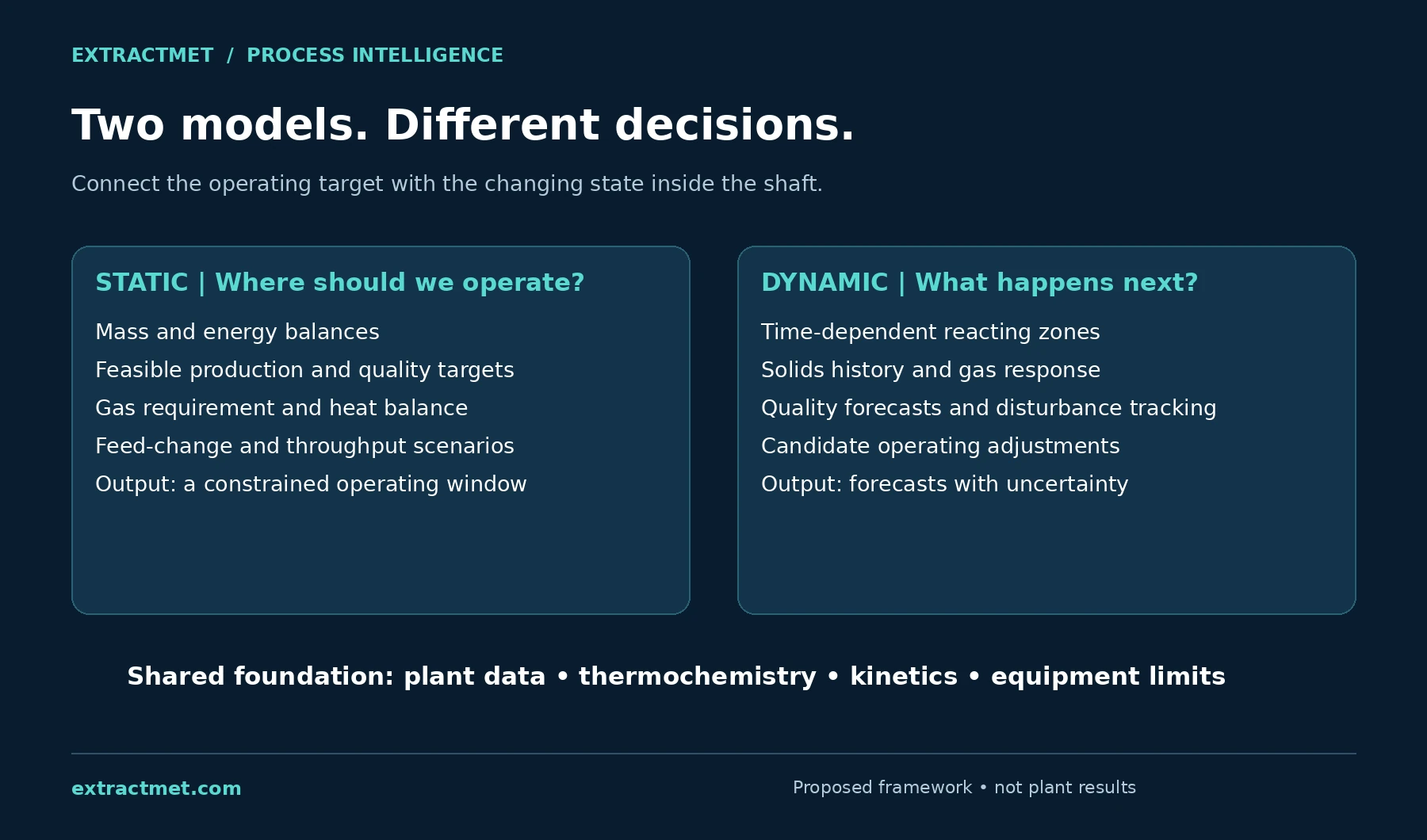 Static modelling evaluates feasible operating targets. Dynamic modelling estimates the path toward those targets and the effects of disturbances.
Static models: establish an operating target that closes the balances
A static model represents a steady or quasi-steady operating condition. It supports questions such as: What reducing-gas requirement is consistent with the production target? What happens to the heat balance when the feed changes? Which constraint becomes active first as throughput increases?
The engineering core should account for iron and oxygen balances, gas species, carbon, and energy. It should represent the relevant reduction, reforming and gas-equilibrium reactions, with kinetic and heat-transfer descriptions appropriate to the intended use. Thermodynamic possibility alone does not establish how much reduction will occur within the available residence time.
For plant teams, the useful output is a comparison of feasible scenarios. Depending on the available measurements and model scope, this can include:
- Estimated gas requirement and gas utilization at a specified production rate.
- Product metallization and carbon estimates within the calibrated range.
- Heat-balance closure and sensitivity to inlet conditions.
- The effect of pellet chemistry, gangue and reducibility on the operating window.
- Constraints that limit an apparently attractive throughput increase.
This gives process engineers a consistent basis for planning trials, comparing feed options and reviewing operation across shifts. The model must also show assumptions and balance residuals: an apparently precise answer is of little use if the inputs do not reconcile.
Dynamic models: anticipate the product still inside the furnace
A steady-state target cannot explain every transition. Material already in the shaft has its own thermal and reduction history. A new feed condition takes time to travel through the bed, while gas and temperature responses follow different time scales.
A dynamic model tracks that evolving state through time-dependent material and energy balances. An interconnected reactor representation can approximate the shaft as multiple reacting zones, with solids moving downward and gas upward. The required spatial detail depends on the decisions the model must support and the data available to validate it.
Such a model can support forecasts of product quality, thermal state and recovery after a disturbance. It can also help operators compare candidate adjustments before implementing them.
For example, suppose a pellet change is followed by an unexpected top-gas trend. The model can test whether the observations are consistent with reduced reducibility, altered gas conditions or a measurement problem. It can then compare feasible responses, while displaying the uncertainty in the diagnosis.
This is a proposed use case, not a report of demonstrated plant performance. Its value must be established against plant records and subsequent operating trials.
Why combine physics with machine learning?
Physics supplies the structure: conservation laws, thermochemistry, equipment relationships and process constraints. Plant data helps identify where that structure needs calibration.
Machine learning can estimate difficult-to-measure parameters, correct systematic model residuals or identify patterns associated with particular operating regimes. A soft sensor can provide an interim estimate of a laboratory property, but its output should remain clearly distinguishable from a measurement.
The strongest implementation is selective. A learned correction should not be allowed to create iron, lose carbon or make an impossible heat balance appear acceptable. It should operate within a framework that checks physical consistency and detects unfamiliar conditions.
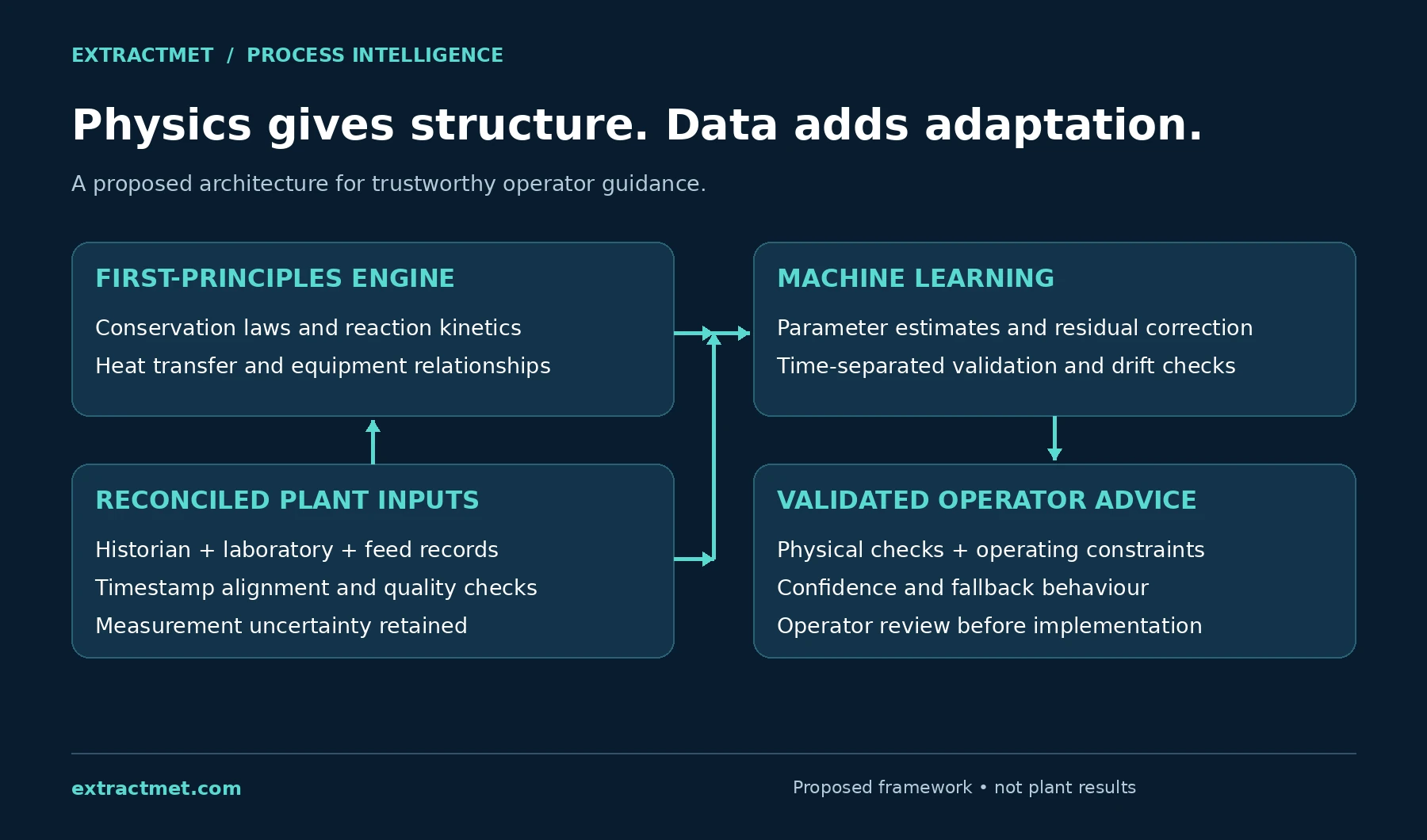 Proposed architecture: reconciled plant data feeds physics and learning components; validated predictions pass through operating constraints before becoming advice.
Validation also needs to respect time. Randomly mixing adjacent operating records between training and testing can make a model appear more accurate than it will be during a future campaign. Evaluation should use later periods, distinct feed conditions and relevant disturbances, with laboratory timestamps aligned to the material being predicted.
When an analyzer drifts, a critical tag disappears or operation moves beyond the training range, confidence should fall visibly. The system should qualify or withhold advice and return to the agreed fallback behaviour.
What should the operator actually see?
A useful screen starts with an operating decision, not a wall of model variables.
It should show the current measured condition, the estimated internal state, the expected direction of product quality, and any proposed adjustment. Beside that adjustment should be its reason, active constraints, prediction confidence and expected response horizon.
For a proposed increase in production, for example, the interface should explain whether gas supply, thermal conditions, residence time or another configured limit restricts the move. Operators should be able to compare the current case with a proposed case and understand the trade-off.
Initial deployment can run in shadow mode, recording predictions without influencing operation. It can then move to operator advisory use after validation. Any later supervisory control integration requires a separately engineered and approved scope; existing basic controls, interlocks and safety systems retain their roles.
Measure the benefit where it matters
The commercial goal is a more consistent and economical operation. The proof should come from agreed plant indicators, not an attractive dashboard.
Relevant indicators include specific natural-gas and energy consumption, metallization and carbon variability, off-specification production, throughput at comparable quality, and recovery after disturbances. Forecast error, availability and the frequency of withheld advice are also useful measures of whether the model can be trusted.
Comparisons need to account for changes in feed, production rate, product specification and operating conditions. A lower gas-consumption number is not automatically an improvement if metallization has fallen or more reduction work has moved downstream.
Where DRI feeds an EAF, the assessment should consider the delivered metallic quality, gangue, carbon and temperature alongside DRI-plant performance. The best local setpoint is not necessarily the best integrated operating choice.
No fixed saving is assumed. Benefits and acceptance criteria should be established from the site’s baseline and verified during the project.
Hydrogen changes the modelling problem, too
Higher hydrogen use changes reduction chemistry and thermal behaviour. Gas circulation, heating and equipment capacity therefore need attention alongside gas composition.
Midrex’s discussion of MIDREX Flex identifies gas compression and heat-recovery considerations during the transition. Its process-gas-heater article also describes the conditioning of alternative reducing-gas sources.
For a modelling project, the implication is clear: hydrogen scenarios should be evaluated against the actual plant configuration, equipment capabilities and product requirements. A conventional natural-gas model cannot simply be relabelled as a hydrogen model.
A practical starting point for your plant
A focused first project should answer one valuable question well: can we anticipate metallization excursions, explain excess gas consumption, or define a more reliable operating window for changing pellets?
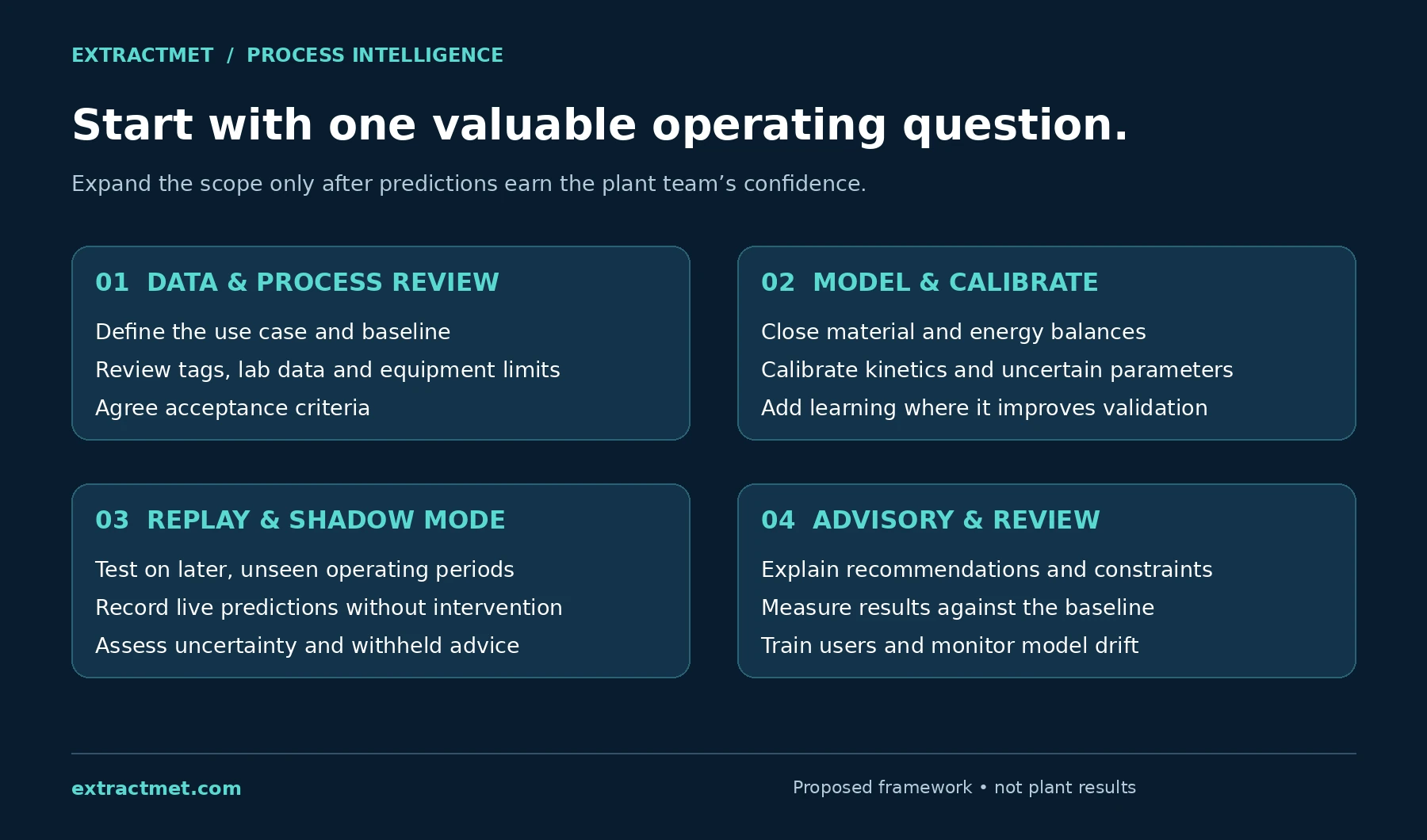 A proposed project sequence. Progression depends on data quality, validation and the plant’s acceptance criteria.
The work can begin with a data and process review: flowsheet, tag definitions, laboratory records, feed characteristics, operating limits and known disturbances. The next stage develops and calibrates the physical model, then adds learning components where they improve independent validation. Historical replay and shadow operation establish whether the predictions are useful before advisory deployment.
Deliverables can be scoped to include the model engine, operator interface, what-if analysis, validation report, integration specification, documentation and training. Data-hosting and access arrangements can be agreed around the plant’s requirements.
ExtractMet’s process optimization and digital-twin services bring this work together with metallurgical engineering and plant-data analysis.
Let us start with your most expensive operating uncertainty
If your team is working to stabilize DRI quality, understand gas consumption or assess a higher production target, start with the decision that is hardest to make today.
Discuss your MIDREX-based DRI modelling requirement with ExtractMet.
Tell us your plant configuration, the operating problem and the data available. We can use that starting point to define a focused modelling and validation scope.
Website: www.extractmet.com
Email: info@extractmet.com
MIDREX® is a registered trademark of Midrex Technologies, Inc. This article describes an independent ExtractMet service proposition and does not imply affiliation with or endorsement by Midrex. Illustrations show concepts and proposed workflows, not installed software or validated client results.
Sources and further reading
- Midrex Technologies — The MIDREX Process. Process description and gas-reforming context.
- Midrex Technologies — Fueling the Future of Ironmaking: MIDREX Flex. Hydrogen-transition considerations.
- Midrex Technologies — Process Gas Heater: Proven Technology for Process Flexibility. Alternative gas-conditioning context.
- ExtractMet — Company capabilities and contact information.
The hybrid-control architecture and deployment workflow above are an engineering proposal; the sources are background references, not evidence of ExtractMet deployment results.